PayID uses a mobile number or email to route a bank transfer; it does not charge a phone account or guarantee fast casino withdrawals.
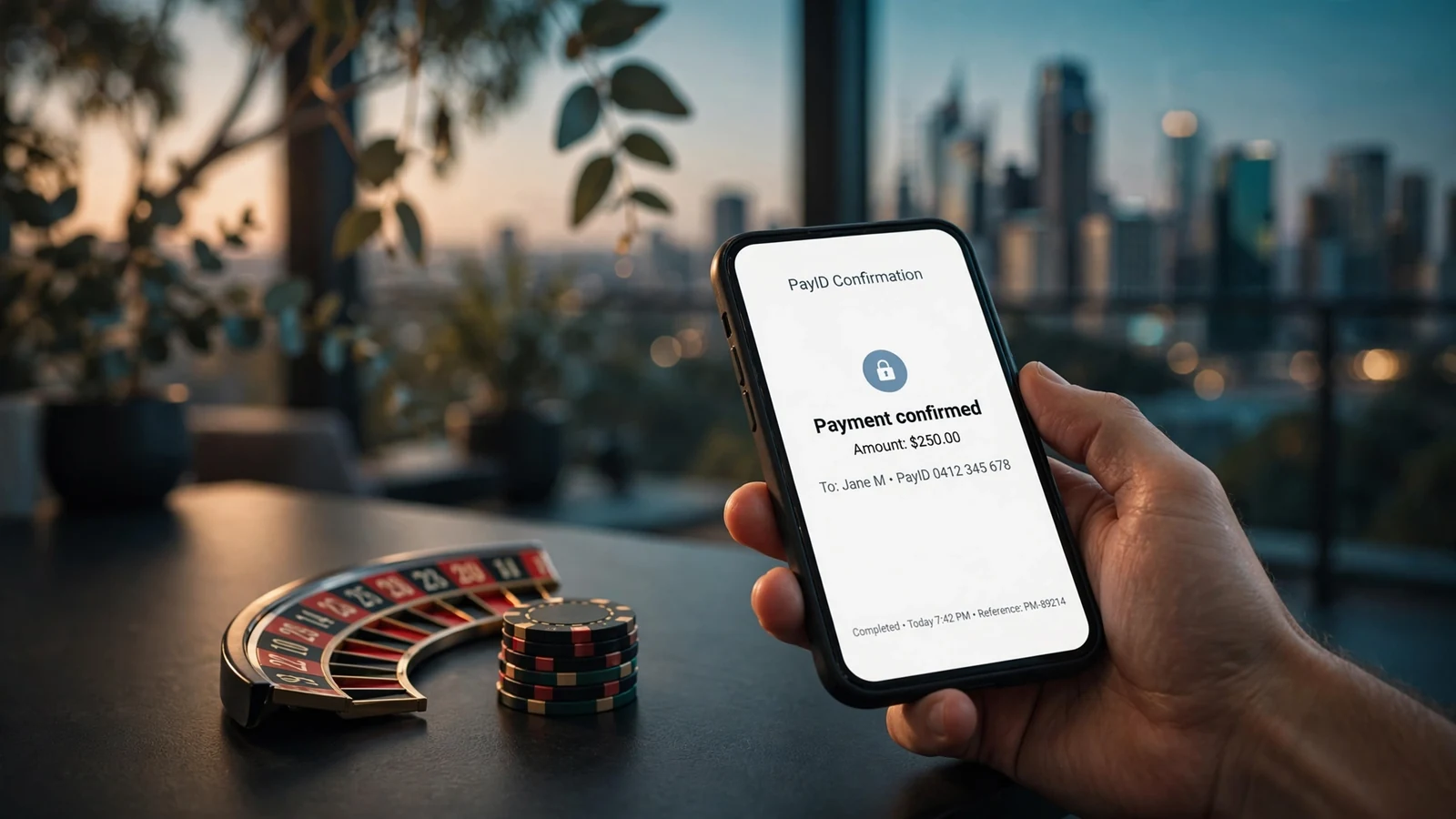
“Pay by phone” can describe two different payment arrangements. In one, a purchase is added to your mobile service bill or deducted from prepaid phone credit. In the other, your mobile number is used as an identifier for a payment sent from a bank account. PayID uses the second arrangement. The number helps direct a bank payment; it does not turn the transaction into a charge on your phone account.
That distinction matters when you see phrases such as “mobile casino payment” or “pay by phone bill casino”. They can suggest that entering a phone number will put a gambling purchase on your next telco bill. A PayID option does not work that way. It is a service on Australia’s New Payments Platform (NPP), through which people can send or receive money using an identifier linked to an account. That identifier may be a mobile number or an email address.
The number is therefore an addressing detail, not the source of the funds. A PayID payment is started in your banking app: you select PayID, enter an amount and confirm the transfer there. The banking app is the point at which you authorise the payment. Your mobile provider is not asked to add the amount to your phone bill, and your phone credit is not used to fund it.
Paying by phone can mean different things, from using a mobile-linked payment service to making a deposit on your phone. Use this list as a starting point, and check directly with each casino which payment methods are currently available to you.
JustCasino
JustCasino is listed with a Curacao Gaming Control Board licence. The available details do not specify phone-payment options, so check with the casino before choosing it for that reason.
Playfina Casino
Playfina Casino is listed under Curacao eGaming, with Hollycorn N.V. holding the licence since 2017. Its minimum deposit is A$20–30 depending on the offer; phone-payment methods are not specified in the available details.
LevelUp Casino
LevelUp Casino is listed with Curacao eGaming licence OGL/2023/174/0082, held by Dama N.V., and a A$15 minimum deposit. The available details do not identify phone-payment methods.
Roby Casino
Roby Casino is listed with a Curacao eGaming licence held by Roby Games Ltd. The available details do not specify its payment methods, so check whether it supports your preferred phone-based option.
Golden Pokies
Golden Pokies is listed with a Curacao licence. No phone-payment or deposit details are provided, so confirm those directly with the casino.
MrPacho
MrPacho has a A$30 minimum deposit, with crypto payouts listed at 30–120 minutes and fiat payouts at 24–72 hours. Phone-payment options are not specified in the available details.
House of Pokies
House of Pokies lists PayID payouts of 1–24 hours and a A$30 minimum deposit, with PayID deposits from A$10. Its licence is described as an international iGaming licence, but the jurisdiction is not named in the available details.
DragonSlots Casino
DragonSlots Casino is listed with a Curacao Gaming Authority licence held by Jumpman Gaming Ltd. The available details do not specify phone-payment methods.
LuckyVibe
LuckyVibe is listed with Curacao Gaming Control Board licence OGL/2023/176/0095, held by Hollycorn N.V. The available details do not identify phone-payment options.
Lucky Dreams
Lucky Dreams lists a A$20 minimum deposit using POLi and a Curacao licence. Check with the casino whether POLi is available to you and whether it suits your payment needs.
A useful way to separate the two methods is to ask which account is being charged. With a phone-bill payment, the amount is associated with the mobile service account or prepaid balance. With PayID, you instruct your bank to send money from the relevant bank account. The fact that the identifier is a phone number does not change that route. It is similar to using an email address to identify a recipient: the address helps locate the payment destination, while the payment itself travels through the banking system.
This also explains why “online casino pay by phone” is imprecise wording. It may mean a carrier-billed purchase, or it may be someone describing a PayID transfer initiated on a phone. The device used does not define the payment method. You can use a mobile phone to open a banking app, but that does not make the resulting bank transfer a mobile-bill charge. Conversely, a phone-bill payment is not PayID merely because a mobile number is involved.
If a payment page presents PayID, treat the displayed instructions as banking instructions, not as permission to charge your telco account. The payment should be confirmed in your bank’s app. Before authorising any transfer, check that the PayID recipient name shown for the payment matches the intended recipient. If the recipient details do not match, do not proceed on the assumption that the phone number alone proves where the money is going.
The same distinction applies to searches for mobile slots or casino games that can be paid for through a phone bill. A payment label does not establish that a game is available, that a phone carrier supports billing for it, or that a transaction is lawful. In Australia, the Interactive Gambling Act 2001 makes it illegal for operators to provide real-money online casino games, including slots, to people physically located in the country. A payment method cannot alter that legal position.
Nor does a phone number become a payment credential simply because it is registered as a PayID. It identifies a payment destination associated with a bank account; it is not a card number, a phone-credit balance, or a facility for borrowing money. The money movement still depends on a bank transfer authorised through the banking app. If you intended to use a carrier-billed service, a PayID instruction is not a substitute for that arrangement.
When reading a payment description, look for the actual mechanism rather than relying on “mobile” or “phone” in the wording. If it says PayID, expect to use your banking app and a linked identifier. If it says the charge will appear on a mobile bill, that describes a different billing route and should not be confused with PayID. A phone can be the screen on which you make a payment, and its number can identify the recipient, without the phone account ever being charged.
Legal Warning
Under the Interactive Gambling Act 2001, it is illegal for operators to provide real-money online casino games to people physically located in Australia.
A PayID deposit has two distinct stages: you set up the payment on the casino’s cashier page, then authorise the transfer in your banking app. The casino’s payment instructions connect the transfer to your account; the bank app is where you approve the movement of money. If the reference is missing or incorrect, the payment can arrive without being matched automatically to your player account.
In Australia, real-money online casino games are prohibited for operators to provide to people in the country under the Interactive Gambling Act 2001. The process below describes how a PayID payment flow is structured; it is not a recommendation to use an online casino.
If a payment page offers PayID, selecting it should display the details needed to make the transfer and any instructions for identifying your casino account. Read these before opening your banking app. Pay attention to the requested payment reference: it may need to contain your player ID or username, rather than only a general description of the payment.
The amount field is subject to the payment page’s stated minimum. PayID deposits commonly begin at AUD 10–20, although some casinos accept a lower amount through bank transfer. These are not universal terms, so the amount shown for a particular payment flow is the relevant one. Do not assume that an amount accepted by one service will be accepted by another.
Before proceeding, check that the payment details and the recipient name match the instructions provided for the transfer. If anything differs, do not guess which detail to change. A payment sent to the wrong recipient or with the wrong identifying information may not be credited as intended.
The payment page may provide a PayID identifier or other transfer details. Open your banking app and enter those details as directed. Check the recipient name displayed by the bank before confirming; this is a final opportunity to catch a mismatch between the intended recipient and the one selected for payment.
Enter the amount you chose and check it against the amount shown on the payment page. Then add the required reference in the payment description or reference field. If the instructions call for your player ID or username, include it accurately. Avoid substituting a nickname, email address or unrelated note unless the payment instructions explicitly request that information.
The reference is not merely a label for your own records. Casinos may use it to match an incoming payment to a player account and credit the deposit automatically. If the required ID or username is omitted or entered incorrectly, the payment may remain pending and require manual processing through support. Rechecking the reference before you approve the transfer can prevent that avoidable mismatch.
After approving the transfer, return to the account page and check whether the deposit appears in the balance or transaction history. Do not send another payment simply because the balance has not changed immediately: first check the transaction status and the reference you used. A second transfer could create a separate payment to reconcile.
PayID Deposit Process
Set up payment
Select PayID on the casino cashier page, enter the amount, and note the required payment reference such as your player ID.
Authorise in app
Open your banking app, enter the PayID details, verify the recipient name, and include the exact reference before confirming the transfer.
Verify balance
Return to the casino account page to check if the deposit appears in your balance or transaction history.
If the payment remains pending, keep the bank transaction details and contact the service through its stated support channel. Explain that the payment has been sent and provide the information requested to identify it. Do not share banking passwords, one-time security codes or other credentials; those are not needed to identify a transfer.
The central point is that successful bank authorisation and successful account crediting are related but not identical events. The bank can process the transfer while the casino’s system still needs to associate it with a player. Using the requested reference, checking the recipient before approval and reviewing the account afterwards are the parts of the process you can verify directly.
A PayID transfer and a casino payout are not one continuous process. The payment network can move money quickly, but a casino may still need to review and approve a withdrawal before it sends anything. The elapsed time therefore depends on two separate stages: the transfer through the New Payments Platform (NPP), and the operator’s own handling of the request.
For a deposit, the player releases a payment through a banking app. PayID transfers generally clear through the NPP in real time; casino deposits are reported to arrive within seconds, often in the range of three to fifteen seconds. That describes movement of the funds, not every step needed for a casino account to show a balance. If a casino has not matched the incoming payment to the right account, its own processing may still be needed.
A withdrawal runs in the opposite direction, but it is not simply the same transfer reversed. You submit a request to the casino. The operator may then review it and decide whether to approve it. Only after that stage does payment-network settlement become relevant. A fast network cannot make an operator review a request faster, and it cannot send a payment the operator has not yet released.
This distinction helps locate a delay. If the casino still shows a withdrawal as awaiting review or approval, the request has not reached the payment stage. The time is being spent inside the operator’s process, rather than waiting for PayID to settle a released transfer. If the casino marks the withdrawal as approved or sent, but the money has not appeared in your bank account, the question shifts to the transfer stage: check the payment status with the casino and your bank.
A specialist review identifies the casino’s internal processing as a potential bottleneck for PayID withdrawals. That is a useful explanation of how delays can arise, not a promise that every operator handles requests on the same schedule. The network’s real-time capability is not a service-level commitment from the casino. An operator may take time to assess a request before releasing payment, and the PayID network cannot remove that interval.
The same separation matters when a deposit appears slow. A transfer may have cleared from your bank while the casino has not yet credited it. In that situation, the money’s arrival at the recipient and the casino’s account-matching process are different events. A payment that has been released but not reflected in the casino balance should not automatically be described as a slow PayID transfer; the delay may be in the casino’s handling of the payment.
When you contact support about a delay, describe the status shown at each end: whether the bank shows the transfer as completed, and whether the casino describes the deposit or withdrawal as pending, under review, approved, or sent. These labels help distinguish a network wait from an operator wait. A broad statement that a payout is “processing” is less informative unless the casino can say which stage is still open.
Payment speed does not establish that a casino is authorised to offer its services in Australia. Australian law prohibits operators from providing real-money online casino games to people physically located in the country. The mechanics of a PayID transfer do not change that legal position.
For people physically in Australia, real-money online casino games and their associated offers sit within a prohibited service category under the Interactive Gambling Act 2001. The conditions below explain how a bonus offer is structured; they are not a recommendation to use an online casino or accept an offer.
A payment method does not determine the bonus rules. PayID describes how a payment is made, while the offer’s terms determine what happens to bonus funds and any winnings associated with them. Read those terms before making a payment or opting in. If the conditions are unclear, do not assume that a short promotional description overrides the detailed rules.
Check whether winnings or bonus funds must be wagered before they can be withdrawn. The terms should say which balance the requirement applies to and what counts as qualifying play. A headline that describes a bonus as large or easy to claim does not explain how much play is required. Do not infer the requirement from the payment method or from the way the offer is advertised.
Also check whether the requirement applies to the bonus, winnings, or both. These distinctions affect how much of a balance may become withdrawable and when. If the wording does not make that clear, the practical value of the offer cannot be assessed from its headline.
Look for a maximum permitted bet while bonus conditions are active. A bet above that limit may breach the terms and can affect eligibility for the bonus or related winnings. Check whether the limit applies only while wagering requirements remain, or throughout another stated period. Do not assume that a normal table or pokies bet is permitted simply because the game is available.
Terms may assign different contribution levels to different games, or exclude some games from bonus progress. This means that playing a particular game may reduce the outstanding requirement slowly or not count at all. Check the offer’s game-weighting rules rather than treating every game as equivalent. A list of eligible games is useful only if it clearly states how each category contributes.
Find when the offer begins, when it expires, and whether a separate deadline applies to completing any wagering condition. A bonus can become unusable or be removed if a stated time limit is missed. Check whether the clock starts when the offer is claimed, when funds are deposited, or at another event specified in the terms. If the start point is ambiguous, do not assume the most favourable interpretation.
Some offers cap the amount that can be withdrawn from bonus play. Check whether the cap applies to winnings from the bonus, the bonus balance itself, or another defined amount. Also check what happens to any balance above the cap and whether the cap applies after wagering conditions are met. A displayed balance does not necessarily equal the amount the terms allow you to withdraw.
Read all these conditions together: a low wagering requirement, for instance, does not make an offer straightforward if the maximum bet, game weighting, expiry rule, or cash-out cap is restrictive. Keep the full terms available when interpreting any promotional claim, and do not rely on a payment label to explain bonus eligibility or withdrawal rules.
“No wagering” and “no deposit” describe different parts of a bonus. Neither phrase tells you that a payment method has special bonus rules, and neither should be treated as a complete statement of what you can withdraw.
A no-wagering claim concerns the play-through condition attached to bonus funds or winnings. It suggests that the stated wagering requirement does not apply, but the claim alone does not explain what happens to winnings, whether other restrictions apply, or whether the offer has a maximum cash-out condition. Read the offer terms to establish exactly which funds the claim covers and what you must do before a withdrawal.
A no-deposit claim concerns how you qualify for the bonus: it indicates that making a deposit is not required to receive that offer. It does not mean that PayID, a mobile number, or another payment method is involved in granting it. Nor does “no deposit” establish that winnings can be withdrawn without conditions. The offer may still set requirements for eligibility, play, or cash-out, so check its terms before relying on the label.
The phrases can also appear together, but one does not prove the other. A bonus described as no deposit may still carry a wagering requirement. An offer described as no wagering may still require a deposit. If both claims appear, confirm that the written terms apply them to the same bonus and explain any remaining restrictions.
This distinction matters when you are comparing offers associated with online casinos or pokies. A page may place a bonus beside PayID as a payment option, but that layout does not establish that PayID qualifies you for the bonus or changes its conditions. The payment method describes how a transaction is made; the offer terms determine how the bonus works. Do not infer a no-deposit offer from the fact that you can pay by phone, or infer no wagering from the presence of a PayID option.
Before accepting an offer, look for the conditions that qualify or limit the headline claim. Check whether the stated wagering rule applies to the bonus, winnings, or both; whether a maximum bet applies; which games count and how; how long the offer remains available; and whether a maximum cash-out limits withdrawals. These details can change what the headline means in practice.
If the wording is ambiguous, treat the label as a summary, not as a promise about payment or withdrawal. The written terms should make clear what is required before funds can be withdrawn. If they do not, avoid assuming that “no wagering” means unrestricted cash-out or that “no deposit” means no conditions at all.
A casino’s payment options cannot establish whether it appears on BetStop. PayID, a phone-bill payment option or the absence of a particular payment provider describes how a payment might be made; it does not verify an operator’s status or make its services lawful in Australia.
That distinction matters when you see claims about a “pay by phone casino not on BetStop”. BetStop status and payment processing are separate questions. A payment method is not evidence that an operator is outside a register, nor does an operator’s claimed status show that it is safe or permitted to use.
The legal position is separate again. Under the Interactive Gambling Act 2001, providing real-money online casino games to people physically located in Australia is illegal for operators. This includes online pokies and other casino-style games. A payment option, an offer of phone-bill funding or a claim about BetStop does not change that rule. This information is not a recommendation to use an offshore casino or a way to find one.
If you are assessing claims about an operator, do not treat payment branding as a substitute for checking what the claim actually covers. “Not on BetStop” is not, by itself, proof of an operator’s legality, reliability or suitability. Likewise, describing a service as a phone-bill casino, or saying it accepts PayID, does not establish its regulatory position.
There is a separate practical issue if you already have an account and are considering a withdrawal. A specialist review reports that casinos commonly require identity checks before a player’s first withdrawal. Completing KYC verification early can help reduce paperwork delays later. Follow the operator’s stated process and provide documents only through its appropriate account or verification channel. This check concerns your account and identity; it does not confirm BetStop status or make a prohibited service lawful.
Keep the questions distinct: the payment method describes the transfer route; BetStop claims concern a separate status; and Australian law governs whether an operator may provide real-money online casino games to people in Australia. None of those answers can safely be inferred from another.
PayID describes a way to transfer money, not a catalogue of games. It operates through Australia’s New Payments Platform: someone with an Australian bank account can send or receive a payment using an identifier such as a mobile number or email address. That tells you how a payment is addressed; it does not tell you what games a service offers.
So the payment method alone cannot establish whether a particular title, pokies game or other casino game is available. Nor does seeing PayID mentioned alongside a game or bonus prove that the game can legally be offered to people in Australia. The Interactive Gambling Act 2001 prohibits operators from providing real-money online casino games, including slots and table games, to people physically located in Australia.
This distinction matters when a page describes PayID casino slots or games you can fund with PayID. The wording may combine two separate claims: that PayID is a payment option, and that a game is in a particular service’s catalogue. One does not verify the other. A payment description cannot confirm a game title, its availability, or whether a real-money service may provide it to an Australian customer.
The same applies to bonus wording. A PayID bonus label does not identify the games to which an offer applies, and it does not show whether a game catalogue is available in Australia. Payment method, promotional conditions and game availability are separate details; do not infer one from another.
Country wording can also change what a page means. A reference to a German PayID casino, for instance, is not evidence about the legal position or game availability in Australia. A country label is not a payment feature and does not make the service applicable to Australian residents.
For an Australian reader, the useful conclusion is narrow: PayID explains a transfer mechanism, not which casino games can be played. It is not a basis for selecting games or treating a real-money casino offer as available in Australia.
A PayID transfer is subject to limits set by your bank, not by the casino alone. Those limits differ between banks, so an amount accepted by one account may be declined by another. Check your bank’s PayID settings before arranging a payment, especially if you intend to transfer an amount close to your personal limit. A failed or blocked transfer does not necessarily indicate a problem with the casino; the bank may simply be enforcing its own controls.
There can also be more than one limit to consider. Your bank may impose a transaction cap or a daily cap, while the casino may set separate deposit limits. Treat these as independent checks: satisfying one does not mean the other will allow the same amount. If the banking app refuses the payment, check the limit shown by your bank rather than repeatedly trying the same transfer.
Currency matters when the bank account and casino account use different currencies. A conversion may then be required, and foreign-exchange fees can add to the cost. Where both accounts use the same currency, you may avoid that conversion expense. Before paying, confirm which currency the casino account uses and whether the amount shown in the banking app matches what you intend to send. A displayed amount can be affected by conversion, so do not assume the casino will receive the same value that leaves your account.
These checks apply whether the payment is described as a mobile casino payment or a way to fund online pokies. The wording does not change the bank’s transfer rules or remove currency conversion. PayID itself is the transfer method; your bank determines the limits attached to your account, and the currencies involved determine whether conversion may be needed.
Bank Limits
A PayID transfer is subject to transaction and daily limits set by your bank, which are independent of any limits set by the casino.
If the transfer limit is too low, use the options your bank provides to manage that limit rather than splitting payments without checking the relevant rules. Confirm the casino’s stated payment conditions as well, and do not proceed until the recipient details and amount are clear. A payment label cannot tell you whether the transfer fits your bank’s limits or what exchange cost may apply.
PayID is a way to address a payment, not a way to borrow money. It operates through the New Payments Platform (NPP), where an identifier such as a mobile number or email address can be used to send or receive a payment. The identifier helps direct the transfer; it does not represent a credit limit or an amount advanced by a lender.
That distinction matters when a payment option is described as “pay by phone” or “casino credit”. Those phrases can refer to different arrangements. A credit facility involves borrowing, with repayment governed by the lender’s terms. PayID itself does not lend you money, set a borrowing limit or create a balance that you must repay later. It is a payment service.
A credit card is different because the card issuer may provide access to borrowed funds under the card agreement. PayID does not turn a payment into a credit-card transaction, and choosing a mobile number or email address as the PayID identifier does not change the underlying payment into credit. The identifier is simply how the payment is addressed within the NPP.
If you are comparing payment options, check what the option actually does rather than relying on labels such as “phone credit”. Look for whether the provider is extending credit, whether repayment is due later, and which account or payment service will be used. For PayID, the core mechanism is a payment sent through the NPP to an identifier. Any separate borrowing arrangement would come from another product or provider, not from PayID itself.
The same principle applies when a casino payment page groups several methods under a broad label. A displayed name does not establish that the method offers credit, nor that it uses PayID. Confirm the payment service and its terms before proceeding. Do not assume that a mobile-number identifier means a charge is being added to a credit account, or that a service described as credit is part of PayID. The two describe different things: one identifies a payment destination; the other concerns how funds are borrowed and repaid.
A “free spins” label describes an offer, not the conditions attached to it. It does not tell you whether a deposit is required, which games the spins apply to, or what happens to any winnings. A “credit” label is equally incomplete: it does not establish that funds can be withdrawn, or that using PayID changes the offer’s rules.
Read the offer terms to determine how it is activated and what restrictions apply to winnings. The key distinction is between promotional value shown in an account and money that can be withdrawn. An offer may have conditions that affect whether winnings become withdrawable; the label alone cannot answer that. Do not infer that an offer is deposit-free from “free spins”, or that a deposit is unnecessary because the offer is described as credit.
PayID is a way to send a payment through a banking app. It does not define an offer, remove its conditions, or make promotional funds equivalent to cash. Keep the payment method separate from the offer wording: each answers a different question.
There is also a legal boundary in Australia. The Interactive Gambling Act 2001 prohibits operators from providing real-money online casino games, including pokies, to people physically located in the country. A promotional label does not change that status.
PayID casino deposits commonly start at AUD 10–20. Your bank sets the transaction limits; most major Australian banks allow AUD 1,000–5,000 per transaction, with daily limits of AUD 10,000–20,000.
PayID deposits typically arrive within 3–15 seconds. If your payment reference is missing or incorrect, crediting may be delayed while the deposit is matched manually.
For verified accounts, withdrawal requests at top-rated PayID casinos are typically reviewed within 2–6 hours. Once approved, a PayID payout may arrive within minutes to hours; the casino’s review is often the main source of delay.
PayID payments are authorised through your banking app, so check that the recipient name matches the payment instructions before confirming. Do not proceed if the details do not match.
PayID payments are authorised through your banking app, so check that the recipient name matches the payment instructions before confirming. Do not proceed if the details do not match.
Yes, PayID can be used for withdrawals where the casino supports it. A casino may require you to withdraw using the same method you used to deposit, where possible.