Most Australian iPhone casino access runs through a mobile browser, while the same account is generally available on desktop.

When someone looks for casino play on an iPhone, they are often trying to work out whether it requires a dedicated app or can run through the phone’s browser. In Australia, browser access is the usual format: most mobile casinos are reached through a mobile browser, and the account used there is generally the same one available on desktop. The word “mobile” describes the device and screen, not necessarily a separate service or account.
That distinction helps make sense of phrases such as online casino play on an iPhone, mobile casino access, or pokies on an iPhone. They can all point to the same practical question: how does a casino website appear and operate on a phone? A browser-based service loads as a web page rather than as an app installed from an app store. The iPhone’s browser is therefore the first place many people encounter this type of mobile interface.
Casino apps are rarely listed on the Apple App Store in Australia. As a result, browser play is the default route for most Australian mobile casinos. This explains why a person searching for an iPhone casino may find a website rather than a conventional app-store listing. The search wording may mention an app, but that does not mean a dedicated iPhone application is available.
Choosing a casino app for your iPhone in Australia means weighing practical details such as licensing and payment terms before you sign up. Use these brief notes to identify which operators offer information relevant to your priorities.
JustCasino
JustCasino is listed with a licence from the Curacao Gaming Control Board. Check whether its licensing details meet your requirements before you play.
Playfina Casino
Playfina Casino is associated with Hollycorn N.V. and has been operating under a Curacao eGaming licence since 2017. Its minimum deposit is A$20–30, depending on the offer.
LevelUp Casino
LevelUp Casino is listed under Curacao eGaming licence OGL/2023/174/0082, held by Dama N.V. Its minimum deposit is A$15.
Roby Casino
Roby Casino is listed with a Curacao eGaming licence associated with Roby Games Ltd. This licensing information offers a concrete detail to consider as you assess the operator.
Golden Pokies
Golden Pokies is listed with a Curacao licence. Consider this licensing detail as part of your own checks before playing.
MrPacho
MrPacho lists crypto payouts at 30–120 minutes and fiat payouts at 24–72 hours. Its minimum deposit is A$30.
House of Pokies
House of Pokies lists an international iGaming licence, though the source does not name the jurisdiction. PayID payouts are listed at 1–24 hours, and the minimum deposit is A$30, or A$10 when using PayID.
DragonSlots Casino
DragonSlots Casino is listed with a Curacao Gaming Authority licence associated with Jumpman Gaming Ltd. This licensing detail may help you assess the operator.
LuckyVibe
LuckyVibe is listed under Curacao Gaming Control Board licence OGL/2023/176/0095, held by Hollycorn N.V. Its licence details are a useful starting point for your checks.
Lucky Dreams
Lucky Dreams is listed with a Curacao licence and a minimum deposit of A$20 when using POLi. Check that this payment option suits you.
A website can present an interface designed for a phone’s narrower screen. Its controls and content are displayed within the browser, so the experience is still mobile even though there is no casino app installed. The browser acts as the layer between the website and the device: it requests the page, displays the returned content and passes along the user’s actions. This is different from opening a standalone application, even if both formats are designed to be used on a phone.
Using the browser also explains the shared-account detail. A mobile visit is not necessarily a separate iPhone-only account. Most Australian mobile casinos use the same account on mobile and desktop, so the device changes how the service is viewed, not which account is involved. That continuity is useful to understand when a person sees references to a mobile version of a casino: “mobile” does not by itself imply a second account or a separate app.
The phrase “on iPhone” can refer to several different things: finding a website that fits a phone screen, opening an account through a mobile interface, or looking for a downloadable app. These are not interchangeable. A mobile-friendly website is still a website, and its presence on an iPhone does not establish that an app-store version exists.
The same distinction applies to searches containing the word “pokies.” In Australian usage, that word refers to slot-style games. A person asking about pokies on an iPhone may be trying to identify whether the content is available in a mobile format, but the wording alone does not tell them whether they will encounter a website or an app. Given the limited availability of casino apps through the Apple App Store in Australia, the browser is the usual format associated with mobile casino access.
This is an explanation of the access format, not a recommendation to use an offshore casino. Australian law prohibits operators from providing real-money online casino-style games to people in Australia. The fact that a website can be viewed on an iPhone does not change that rule or make the service Australian-licensed. Access technology and legal status are separate questions.
When evaluating a description of an iPhone casino, separate three claims: that the service can be viewed on a phone, that it has a dedicated app, and that it is permitted to offer gambling to people in Australia. One claim does not prove the others. A mobile website may be accessible in a browser without being an app, and a mobile layout does not establish that an operator is authorised under Australian law.
This distinction is especially important when a listing uses “app” loosely. Some descriptions use the word to mean any mobile-accessible service, while others mean software installed on the device. The app-store context matters: casino apps are rarely listed on the Apple App Store in Australia, so a browser-based page is the more common form. The label in a heading or advertisement should not be treated as proof of a downloadable application.
Mobile casino access on an iPhone is typically browser-based rather than via a dedicated app, and usually utilizes the same account as the desktop version.
For an iPhone user, the basic access picture is therefore straightforward: mobile casino activity is commonly presented through a browser, while the account can be the same as the one used on desktop. Searches mentioning an iPhone, mobile play or pokies may all be asking about this format. They do not, by themselves, tell you whether a native app exists or whether an operator may legally provide the service in Australia.
The legal position depends on who is providing the service. Under the *Interactive Gambling Act 2001*, an operator must not offer online casino-style games to people located in Australia. That includes casino games accessed on an iPhone, whether through a website or an app. The restriction applies to the operator’s conduct; it does not make an individual Australian punter’s act of playing at an offshore casino illegal under that Act.
This distinction can be easy to miss when a site is reachable from an Australian connection. Access does not mean the service is authorised in Australia, and a site’s claims about its own licence do not change the Australian rules for operators. Offshore casinos accepting Australian users are not Australian-licensed. A licence issued elsewhere is not local approval to provide real-money casino games to people in Australia.
Casinos that accept Australian players may refer to licensing jurisdictions such as Curaçao, Malta, or Gibraltar. The Malta Gaming Authority (MGA) is a regulator in Malta; Curaçao and Gibraltar are also associated with offshore casino licensing. Such a licence relates to the operator’s obligations in that jurisdiction. It does not override the *Interactive Gambling Act 2001* or turn the operator into an Australian-licensed casino.
A licence can still be relevant to understanding where an operator claims to be accountable, but it should not be mistaken for protection under Australian law. If you are considering an offshore site, check whether it explicitly accepts people located in your state or territory before depositing. A site being visible on an iPhone, or allowing registration, is not proof that it accepts your location or that its service is lawful for the operator to provide in Australia.
The Australian Communications and Media Authority (ACMA) enforces rules relating to illegal online gambling services and actively blocks access to illegal gambling sites. A block can prevent a website from loading, but it does not make a blocked service Australian-licensed. Nor is the block a customer-support measure: ACMA is not the operator’s payment department and does not resolve ordinary disputes between a punter and an offshore casino.
If an offshore casino refuses to pay winnings, there is no Australian government body you can complain to for recovery of those winnings. A foreign licensing authority may have its own complaint process, but that is not an Australian government remedy and does not guarantee a particular outcome. The practical issue is that the operator and the claimed licensing jurisdiction are outside Australia’s local consumer and gambling arrangements.
Legal Risk
Under the Interactive Gambling Act 2001, operators are prohibited from providing real-money online casino-style games to people located in Australia.
This matters before money is sent, not only after a dispute. Terms on an offshore site may set out procedures for account checks, complaints, or withdrawals, but reading them does not create Australian oversight. If the operator rejects a claim, closes an account, or does not respond, an Australian punter may have limited practical ways to obtain a resolution.
You must be at least 18 to register and gamble in Australia. Meeting the age threshold does not change the rule applying to operators: an adult’s ability to use a phone or open an account does not authorise an offshore casino to provide prohibited online casino services to someone in Australia.
So, when you encounter wording about real-money casino play on an iPhone, separate three questions: whether the operator is permitted to serve people in Australia, whether the site accepts your location, and what recourse exists if a payment or winnings dispute occurs. The first is governed by Australian law, the second must be confirmed with the operator before depositing, and the third is not backed by an Australian government complaint body for unpaid offshore winnings.
The word “app” can describe two different things on an iPhone. A native app is installed through a store or another distribution method and runs as software on the device. Browser play opens a casino website in Safari or another mobile browser. A Progressive Web App (PWA) remains website-based but can behave more like an app once saved to the iPhone’s home screen. These formats can look similar on the screen, but they rely on different delivery methods.
For Australian users, browser access is the usual format. Casino apps are rarely listed in the Apple App Store or Google Play in Australia, so casinos that accept Australian players tend to provide a mobile website or a PWA rather than a native iPhone app. The limited store presence is connected to the Australian environment for real-money online casino services: the Interactive Gambling Act 2001 prohibits operators from providing those games to people in Australia. This does not mean an iPhone is technically unable to run a casino app; it means native apps are not the standard route for accessing these services here.
That distinction matters when you assess an app-shaped icon or a page that asks to be saved to your home screen. A PWA is still a website, not a native app downloaded from Apple’s store. Its game screens and navigation may be designed to resemble a mobile app, but the experience depends on the casino website and the browser technology supporting it. Saving it as a shortcut changes how you open the site; it does not change the nature of the service.
Browser play also avoids the need to locate a store listing. You open the casino’s mobile website in a browser and use the site there. Where the operator supports a PWA, it may offer a home-screen shortcut as another way to return to the same website. In either case, the account and site content remain tied to the operator’s online service, rather than to a separate iPhone application. The exact appearance and available functions can therefore vary between websites.
Software installed through a store or other distribution method that runs directly on the device.
Accessing a casino website through Safari or another mobile browser without installing software.
A website-based shortcut saved to the home screen that behaves similarly to a native app.
A native app can be built specifically for a device platform, while a mobile website must work through the browser. That is a difference in how the software is delivered, not a guarantee that one format will be more reliable or easier to use. A polished website can provide an app-like layout, and a native app can still depend on an internet connection and the operator’s systems. The label alone does not tell you how well the service works on your iPhone.
If you are looking for casino games on an iPhone, it helps to check what is actually being offered: a native application, a browser-based site, or a PWA shortcut. Those terms describe access formats, not separate kinds of games. A listing or home-screen icon that looks like an app does not by itself establish that it came from the Apple App Store or that it is native software.
Browser access is therefore the default, not a workaround that proves your device is missing a required application. The choice is generally between using the casino website directly and using a website shortcut where one is available. Before depositing, confirm that the site accepts your location. Offshore services may be crypto-friendly, but that does not make them Australian-licensed; if an offshore casino refuses to pay winnings, there is no Australian government body to handle a complaint.
An iPhone game that uses virtual credits is different from real-money gambling, even when its reels, symbols and play sequence resemble those of a casino game. The credits are part of the app’s play system: they let you take turns within the game, but they are not a cash balance. Playing with them does not provide a route to withdrawable winnings.
Social and free-play casino apps that use virtual credits are available through the Apple App Store and are legal to use in Australia. That availability applies to the free-play format; it does not mean that the same store offers real-money casino gambling. The label “free” describes the play model, not a way of practising with cash stakes or later converting results into money.
This distinction matters when you are looking for a slot-style app for an iPhone. A free game may reproduce familiar casino-style features, but its outcome remains within the app. If you are trying to identify whether an app involves real money, look at what happens to the credits: in virtual-credit play, they are used for in-app turns rather than deposited as money or paid out as winnings. A realistic interface does not change that.
The phrase “real-money slot machine app” can also describe a different kind of service from a free game downloaded through an app store. In Australia, operators are prohibited from providing online casino-style games, including slots, to people located in the country. So an app-store listing for free play should not be read as evidence that real-money play is available through the store. Nor does a free game become a real-money service because it uses casino-like visuals or terminology.
It helps to keep three things separate: the game’s appearance, the credits used to play it, and whether money can be deposited or winnings withdrawn. Appearance alone tells you little about the payment model. Virtual credits indicate an in-app play balance, not cash held for you. If an app or a linked service makes a separate claim about cash deposits or payouts, assess that claim as a separate service rather than assuming it follows from the free game.
Attention: Virtual credits in free-play apps are for in-app use only and cannot be converted into real money or withdrawn as winnings.
Free-play apps can suit someone who wants to interact with a casino-style game without staking money. They do not provide a reliable measure of how real-money gambling would work: there is no cash stake or cash payout in the virtual-credit session. Treating a free result as an expected cash result confuses two different systems.
Before installing, read the app’s store description and its own explanation of credits. Check whether it describes the experience as social or free play and whether it says credits are virtual. Do not infer a cash value from a credit count, a score, or a celebratory screen. Those are game elements unless the service explicitly establishes otherwise. For an iPhone user, the practical dividing line is simple: free-play credits support play inside the app; they are not money to win or withdraw.
When an iPhone game is described as free pokies, “free” refers to the way the game is played: it uses virtual credits rather than money staked for a cash return. That distinction matters because the screen may resemble a casino game, but the credits are part of the game’s scoring system, not a cash balance.
Social and free-play casino apps that use virtual credits are legal to use in Australia and can be found in the Apple App Store. Their presence there does not mean that a real-money casino service is being offered through the app. The relevant difference is whether the play uses virtual credits or money that can be won and withdrawn.
In a free-play game, credits let you continue interacting with the game’s features. They do not establish that you have deposited money, won cash, or acquired a balance payable to you. A result shown inside the app is therefore an in-game result. Treating it as a cash prize would confuse the game’s internal scoring with a real-money transaction.
This is also why a free pokies app for iPhone is not the same thing as a casino offer with no deposit. The word “free” can describe a social game with virtual credits, while a no-deposit bonus refers to a promotion connected to real-money gambling. They are different products and should not be read as interchangeable labels. A free-play game does not, by itself, provide a route from virtual credits to cash winnings.
If you are assessing an app, read its description and rules for how credits work. Check whether they are identified as virtual, whether the app describes cash prizes or withdrawals, and whether any payment is involved. Do not assume that a game is free in every respect simply because it lets you begin without paying: the term alone does not explain all of its features or conditions.
The same distinction applies when people look for Australian pokies on an iPhone. An Australian audience or Australian-themed presentation does not change what the credits represent. The useful question is whether the game is social play with virtual units or real-money gambling. Store availability is consistent with the former; it is not proof that the latter is authorised or available through that app.
Free-play games can still be used for entertainment, but their outcomes remain within the game unless its terms say otherwise. Keep that boundary clear: virtual credits are not a deposit, and a displayed credit total should not be treated as money owed to you.
Free-play games use virtual credits for social entertainment, whereas a no-deposit bonus is a promotion linked to real-money gambling.
When pokies on an iPhone freeze, load slowly or stop responding, the cause may be the device or its connection rather than the game itself. A specialist review identifies weak connectivity, limited available memory, an outdated browser and numerous open background apps as possible sources of mobile casino problems. These factors affect how a page and its interactive elements are delivered and processed.
Start by checking whether the problem is consistent. If other pages also load slowly, the connection may be the limiting factor. Move to a location with a stronger signal or try another available connection, then reload the page. A short interruption can prevent game content from arriving completely; repeated reloads while the connection remains unstable may simply repeat the failure.
If other websites work normally but the game stalls, check the iPhone’s available memory. Apps running in the background can compete for device resources. Close apps you are not using, then reopen the browser and try again. This can help when the page has loaded but responds slowly, or when the iPhone becomes less responsive during play.
The browser itself is another variable. An outdated version may handle newer website features less reliably. Check for available browser updates and install them before testing again. If the problem persists, close the affected page, reopen the browser and load the site afresh. This helps distinguish a temporary page failure from a repeatable issue.
Pay attention to the point at which loading stops. A blank page or a game that never appears can indicate a connection or browser problem. A page that opens but becomes sluggish after other apps have been used may point to limited memory. If the same failure happens after changing the connection, closing background apps and updating the browser, the cause may be specific to the site or its game content rather than the iPhone.
Change one condition at a time when testing. For example, first try a stronger connection without changing other settings; then close background apps and test again. If several things are changed at once, it becomes harder to tell which one affected the result. Note whether the problem affects only one page or several, and whether it occurs repeatedly. That information can make a technical support report more useful.
Avoid treating every slow load as proof that the game is faulty. Mobile performance depends on the connection, browser and device resources working together. A simple sequence—check the connection, free memory, update the browser, then reload—can help isolate the source without assuming that a particular game or iPhone model is responsible.
An iPhone casino may be reached through a website or an app file offered outside the Apple App Store. Treat those routes as different security situations. A website runs in the browser; a sideloaded app is software installed from outside the usual store process. Its safety depends on the operator and on what permissions or device access the app requests. Avoid installing it if you cannot establish who provides it, why it needs those permissions, and how it handles account information. A familiar-looking icon is not evidence that an app is safe.
Offshore crypto-friendly casinos are not Australian-licensed services. Before depositing, confirm that the site accepts people located in your state or territory; an accessible page does not itself establish that you are eligible to use it. If the site later refuses to pay winnings, there is no Australian government body to which you can complain for resolution. Consider that risk before sharing identity or payment information, not only when requesting a withdrawal.
Do not use a VPN to get around a block or location restriction. The operator may treat the altered location as a breach of its terms, which can result in winnings being voided or the account being closed. A VPN also does not make a blocked service locally authorised or remove the need to check the operator’s rules.
If you choose to use a service, inspect its account controls before putting money at risk. A specialist review describes controls that may let you cap deposits, losses, or wagering, restrict session time, or exclude yourself from the account. Their availability and operation can vary by operator, so check whether a limit takes effect immediately, whether it can be changed, and what self-exclusion prevents. A control is useful only if you understand what it blocks and when it applies.
Keep account credentials private, use a unique password, and avoid entering them through links in unsolicited messages. If an app or site asks for information unrelated to operating the account, stop and verify the request through the operator’s official channel. These checks reduce avoidable exposure; they do not remove the financial or dispute risks of using an offshore service.
A Progressive Web App, or PWA, is a shortcut to a casino website that opens in a format designed to behave more like a native app. The games and account still belong to the website; adding the shortcut does not install a separate casino program in the same way as downloading an app from the App Store.
To add one, open the casino’s website in your iPhone browser and look for an install or add-to-home-screen prompt. Tap it, then confirm the installation when the iPhone asks. The site’s shortcut should then appear on your home screen. The exact prompt and its position can depend on the website and browser, so follow the controls displayed on the page rather than relying on instructions for a different site.
When you open the shortcut, the PWA loads the casino website. You may need an internet connection, and signing in remains tied to your website account. Adding the shortcut does not create an account, verify that the site accepts your location, or change the conditions attached to that account. Confirm that the site accepts users in your location before depositing.
A PWA is not the same as a sideloaded app. A website shortcut does not require you to download an installation file from an unknown source or grant the permissions requested by a separate app. Sideloaded casino apps carry security risks, and their safety depends on the operator. Do not treat an install prompt as proof that a service is safe or authorised.
Installing a PWA
Open Website
Load the casino's website using your iPhone browser.
Trigger Prompt
Look for the install or add-to-home-screen prompt on the page.
Confirm Addition
Tap the prompt and confirm the installation when prompted by the iPhone.
If a site is blocked, do not use a VPN to try to reach it: doing so may void winnings or result in account closure. Offshore casinos are not Australian-licensed, and there is no Australian government body to complain to if one refuses to pay winnings. A home-screen icon changes how you open a website; it does not change these risks or the nature of the service.
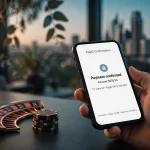
On an iPhone, a payment can appear to complete before the casino account balance updates. The payment service must approve the transaction, and the operator must then record it against your account. If either step is delayed or declined, the balance may not change immediately. Check the transaction status before trying again; a second attempt could create another payment request.
A specialist review describes PayID deposits as near-instant and typically free, but timing and fees can depend on the service handling the transaction. Treat those details as something to confirm in the payment screen and the operator’s terms, rather than assuming they apply to every account. POLi is no longer an option for local transactions: it ended its Australian operations in September 2023.
A deposit and a withdrawal are separate processes. Even when a deposit is credited quickly, a withdrawal may be held for identity checks or operator processing. A first withdrawal commonly requires KYC verification: you may need to provide identification, such as a selfie or ID, and proof of address. If those details are incomplete or do not match your account information, processing can take longer.
Payment rules also differ by method. Some operators require withdrawals to use the same method as the deposit, while other methods may be deposit-only. A payment option appearing on the deposit screen does not therefore guarantee that it can receive a withdrawal. Check the cashier’s rules and any withdrawal limits before depositing, including whether the limit applies per transaction or over a set period.
Card deposits can fail because a bank may block or flag a gambling-related charge. A declined payment is not proof that the casino account is at fault, and repeated attempts may not resolve the issue. Do not use a credit card to fund gambling. Before making any payment, confirm the available method, fees, processing stages and withdrawal conditions directly with the service.
A bonus changes the conditions attached to a balance; it does not make that balance equivalent to cash. Before claiming an offer for iPhone casino games, read its full terms and check four points: the wagering requirement, eligible games, expiry date and cashout cap. If any of these is unclear, you cannot reliably predict what happens to the bonus or any winnings linked to it.
The wagering requirement states how much qualifying play is required before a bonus can be withdrawn. A specialist review reports welcome-offer requirements commonly ranging from 30x to 50x the bonus amount. The multiplier’s base matters: terms may calculate it against the bonus alone or against the deposit and bonus together. Those calculations produce different totals, so check the exact wording rather than judging an offer by its headline.
Game restrictions determine which play counts towards clearing the requirement and whether different games contribute at different rates. A game you prefer may contribute less, or not count at all. Check this before accepting, because play that does not qualify will not move the requirement towards completion.
Expiry rules set the time available to meet the conditions. A specialist review reports that many offers give 7–10 days, with the bonus lost if the deadline is missed. Treat the stated expiry as a condition, not a reminder: if you cannot meet it within the permitted period, the offer may have no practical value.
Finally, check the cashout cap. It limits the amount that can be withdrawn from bonus-linked winnings, even after the other conditions are met. Confirm whether the cap applies to winnings, the bonus balance or both.
Compare the complete terms, not the advertised bonus amount. Check every condition before claiming; if the wagering rules, restrictions, deadline or cap do not suit your circumstances, decline the offer.
Yes. Social and free-play casino apps with virtual credits are legal to use in Australia and are available through the Apple App Store and Google Play.
No. Most mobile casino access is through a browser, and some services offer a Progressive Web App that can be added to your home screen.
A native app is installed software, while a browser casino is a website you open on your phone. A Progressive Web App is a website shortcut that can behave like a native app.
Operators must not offer online casino-style games to people in Australia under the Interactive Gambling Act 2001. Playing at an offshore casino is not illegal for an individual player under that Act.
Mobile casinos commonly use browser play, so a dedicated app is not required for access. However, operators are prohibited from offering real-money online casino-style games to people in Australia.