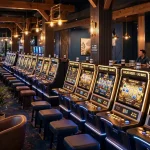
Live streams show dealers using physical equipment, while digital games generate outcomes with software; the distinction shapes how each round is presented.

Online table games can be delivered in two different ways: through a live video stream of a dealer using casino equipment, or through a digital game in which software generates the outcome. The distinction is about where the game’s events come from. In a live-dealer format, the dealer and equipment are real; in a digital format, the result is produced by a random number generator (RNG).
A live-dealer game uses a real dealer and real casino equipment. Video of the activity is streamed to players, so the screen shows a live event rather than an entirely software-generated scene. The dealer and equipment are part of the game’s physical setup; the stream carries their activity to the viewer.
This makes the video stream the way you observe the game, not the same thing as a digital animation of a result. The defining feature is that a real dealer operates real equipment while the action is streamed. The game is therefore delivered through a combination of a physical table and online video.
When choosing a real-money casino for table games in Australia, it helps to check the available operator details before deciding where to play. Use these short verdicts as a starting point for your own checks.
JustCasino
JustCasino is listed with a Curacao Gaming Control Board licence. You can use that detail as one point of reference when assessing the operator.
Playfina Casino
Playfina Casino is listed as operating under Curacao eGaming through Hollycorn N.V., since 2017. Its minimum deposit is A$20–30, depending on the offer.
LevelUp Casino
LevelUp Casino is listed under Curacao eGaming licence OGL/2023/174/0082, held by Dama N.V. Its stated minimum deposit is A$15.
Roby Casino
Roby Casino is listed with a Curacao eGaming licence through Roby Games Ltd. You can consider this licensing information when reviewing the operator.
Golden Pokies
Golden Pokies is listed with a Curacao licence. The available information provides a licensing detail, but no further operator-specific facts.
MrPacho
MrPacho lists crypto payout times of 30–120 minutes and fiat payouts of 24–72 hours. Its stated minimum deposit is A$30.
House of Pokies
House of Pokies lists an international iGaming licence, though the source does not name the jurisdiction. PayID payouts are listed at 1–24 hours; the minimum deposit is A$30, or A$10 for PayID.
DragonSlots Casino
DragonSlots Casino is listed under the Curacao Gaming Authority through Jumpman Gaming Ltd. You can take this licensing detail into account when considering the operator.
LuckyVibe
LuckyVibe is listed with Curacao Gaming Control Board licence OGL/2023/176/0095, held by Hollycorn N.V. The available facts identify its licensing arrangement.
Lucky Dreams
Lucky Dreams is listed with a Curacao licence and a minimum deposit of A$20 via POLi. These details may help you assess whether its stated payment option suits you.
A stream does not change the basic distinction between seeing an event and generating one. In the live format, the dealer and equipment provide the visible action. In a digital version, the software determines the outcome, even if the screen presents it as a table game. A realistic-looking display alone does not tell you which delivery method is being used; the relevant question is whether the game is showing live dealer activity or presenting a software-generated result.
Digital table games use an RNG to determine outcomes. For example, in an online card game, the RNG determines which cards are dealt. In a digital roulette game, it determines where the ball lands. The outcome is generated by software rather than being captured from a real dealer operating a physical table.
The screen is the way the digital result is presented to you. It may depict cards or a roulette wheel, but the underlying event is determined by the RNG. That is the essential difference from a live-dealer stream: a digital display can represent table-game activity without a physical dealer or equipment producing the outcome in real time.
The two delivery methods can therefore look similar at a glance while working differently. Both can show a table-game interface, but one transmits live activity and the other displays an outcome generated by software. To identify the format, focus on what produces the game event, not merely on whether the screen contains a dealer, cards or a wheel.
Delivery method explains how an online game reaches a screen; it does not, by itself, explain every rule or determine whether two games play alike. A live stream tells you that the visible action comes from a real dealer and equipment. An RNG-based version tells you that software determines the relevant outcome. These are separate ways of producing and presenting a game, not interchangeable descriptions of the same process.
The distinction also avoids a common source of confusion: “online” does not necessarily mean “digital.” A game can be online because its live video is streamed to players, even though a real dealer and physical equipment are involved. Conversely, a digital game can resemble a physical table without using one. In both cases, the player receives the game through a screen, but the origin of the action differs.
This is a description of delivery, not a recommendation to access or use a service. In Australia, the Interactive Gambling Act 2001 prohibits operators from providing real-money online casino games, including table games, to people in the country. Understanding the difference between a live stream and an RNG-based display does not alter that legal restriction.
A payment method and a game outcome belong to different parts of an online transaction. Bitcoin may be discussed as a way to transfer funds, but the method of payment is not what determines the cards dealt or the roulette result. In an online table game, a Random Number Generator (RNG) determines those outcomes.
In an online table game, a Random Number Generator (RNG) determines the outcomes, regardless of the payment method used.
That distinction helps make sense of searches for Bitcoin table games compared with ordinary casino table games. The wording can make it sound as though Bitcoin creates a separate kind of blackjack, poker or roulette. It does not, by itself, describe a different game. The relevant question about an online game is how its outcome is produced; the payment method is a separate feature.
For a digital game, the RNG supplies the random result. Paying through a particular method does not change that mechanism: it does not deal a different set of cards or direct the roulette ball to a particular pocket. Likewise, calling a game a Bitcoin table game does not, on its own, tell you its rules, how the game is delivered or how its odds are set. Those are properties of the game and its implementation, not consequences of the payment label.
This is also why a search for the best Bitcoin casino table games cannot be answered by treating Bitcoin as a game category. The label identifies a payment association, not a measurable quality of the table game. It does not establish that a game has better odds, different rules or a different way of generating results. “Best” would need a specific criterion, and the currency or payment method alone supplies none.
The same separation applies to phrases such as “table games for Bitcoin” or “top casino table games.” A table game’s name or category describes the activity; a payment method describes how a transaction is made. Putting the two terms together does not establish that the game has been changed or that one version is preferable. Nor does a payment label establish whether a particular game or service is available to you.
 Pokies & Games: Slots and Casino Game TypesExplore Australian online pokies, slot types, jackpot games, crash and table games, plus formats such as live dealer, bitcoin, mines and plinko.
 New Australian Online Pokies: A Careful GuideUnderstand how the Interactive Gambling Act 2001 applies to offshore casino services and why an overseas licence does not ensure Australian protections.
The distinction matters because familiar wording can blur separate mechanisms. A game can have rules governing what counts as a result, and an outcome-generation system that selects the result. A payment method sits outside those game mechanics. If the online version uses an RNG to determine dealt cards or where the roulette ball lands, those are the outcomes it determines; Bitcoin does not become part of that random selection simply because it is named alongside the game.
There is also an Australian legal boundary. Under the Interactive Gambling Act 2001, operators are prohibited from providing real-money online casino games, including table games, to people physically located in Australia. A payment method does not alter that restriction or turn a prohibited service into a permitted one.
So “Bitcoin versus normal casino table games” is not a comparison between two game mechanics. It combines a payment term with a game term. To understand how an online table-game outcome is produced, focus on the game’s outcome-generation mechanism. The payment label alone tells you nothing about a different set of rules or a different result-selection process.
A table game’s objective is not the same thing as its odds. Knowing what a player is trying to do does not, by itself, reveal how likely a particular result is or how much a winning bet pays. Those are separate parts of a comparison.
A description of a game's objective alone cannot establish its house edge or show whether it has better odds than another table game.
In blackjack, the player competes with the dealer to finish with a hand value closer to 21. That describes the contest, but it does not establish a house edge or show whether blackjack has better odds than another table game. To make that comparison, you would need to know the applicable game rules and how outcomes translate into payouts. A description of the target alone cannot supply either result.
The same distinction applies to a game in which a player may bet on their hand, the Banker’s hand, or a tie. Those are choices of outcome to back. The list of choices does not tell you the probability of each result, the amount paid when a selection wins, or how the game handles other outcomes. Without those elements, the choices cannot be ordered from most to least favourable.
A house-edge chart is useful only when it compares like with like and states the conditions behind its figures. The game name alone is not enough: versions of a game can operate under different rules, and a bet’s payout matters alongside the chance of winning it. A chart that does not make its assumptions clear can give a precise-looking ranking without showing what that ranking applies to.
“Best odds” can also mean different things. You might mean a higher chance of winning a particular bet, a lower expected loss over repeated play, or a larger payment if a bet wins. These measures are related, but they are not interchangeable. A bet that wins more often does not automatically produce the most favourable overall return; the payout and the outcomes that lose also matter.
For that reason, calling one table game the best choice on odds requires a defined measure and enough information to calculate it under stated conditions. The objective of blackjack and the available betting choices in another game do not provide a basis for naming a winner, or for identifying a game with the worst odds. A comparison that leaves out the conditions is not a reliable ranking.
The same restraint applies to a table-games odds chart. It should identify the game version, the bet being assessed, the rules and payout assumptions, and the measure being compared. Otherwise, readers cannot tell whether figures refer to the same kind of bet or whether a ranking would hold under a different set of rules.
When you see a claim about the best odds at casino table games, separate the claim into its parts: which game and bet it concerns, what probability or return it measures, and the conditions used. If those parts are not clear, the claim does not tell you enough to compare games responsibly. A stated objective or a menu of betting choices can explain what a player is trying to predict; it cannot, on its own, settle which game offers the most favourable odds.
A table-game round links a player’s decision or action to a defined objective. In blackjack, that objective is to have a hand value closer to 21 than the dealer’s. In a dice game, the player rolls a pair of dice and places a bet on the outcome. These examples have different moving parts: blackjack compares hand values, while the dice game connects a roll with a wager.
Objective is to finish with a hand value closer to 21 than the dealer's hand.
Player rolls a pair of dice and places a bet on the outcome.
The central comparison in blackjack is between your hand and the dealer’s. The aim is not simply to make a hand worth 21; it is to finish closer to 21 than the dealer. That distinction matters because the result depends on the relationship between the two hand values, not on your hand viewed alone.
You can think of the round as a comparison with a target. The target is 21, and the dealer’s hand provides the opponent’s result. A hand may be close to the target, but that fact alone does not establish whether it beats the dealer. The dealer’s value matters too. The round’s objective is therefore competitive: your result is assessed against another hand.
This gives you a straightforward way to understand what a blackjack round is trying to resolve without confusing the objective with a full set of rules. The aim is to get closer to 21 than the dealer; the specific actions available during a round and the way a result is settled depend on the rules in use. No single hand value can be judged as a win or loss without the comparison.
A dice round has a different structure. You roll a pair of dice and bet on the outcome. The roll supplies the event to which the bet relates: the player’s action produces a result, and the wager concerns that result.
 Safe Online Pokies in Australia: Legal and Payment RisksLearn how Australian law treats offshore real-money pokies, what PayID and Bitcoin checks can establish, and what to verify before a withdrawal.
 Bonus buy slots in Australia: rules and demosLearn how Australian law treats offshore casino operators, what slot demos reveal about bonus buys, and why free play cannot confirm real-money…
The important point is the link between the two. The bet is not a hand competing against a dealer, as in blackjack. It is a wager on what happens when the dice are rolled. The exact outcomes a player may bet on depend on the game’s rules, so the basic description does not by itself specify a betting menu or how each possible result is settled.
Both examples make a round easier to follow when you separate its parts: what happens, what the player’s objective or wager concerns, and what result is being assessed. In blackjack, the relevant comparison is between hand values and the target of 21. In the dice game, the relevant event is the roll of a pair of dice and the bet placed on its outcome. Those are distinct ways of structuring play, not interchangeable descriptions of the same process.
In Australia, the Interactive Gambling Act 2001 prohibits operators from providing real-money online casino games to people physically in the country. This is a description of game mechanics, not an invitation to play for money.
A request for a casino close to you is about physical location: it asks whether a venue exists within a relevant distance. An interest in online table games is a different matter. It concerns services accessed through the internet, not a building you can travel to. Combining the two ideas does not establish that a nearby venue exists, where it is, or whether it offers table games.
Legal Restriction
Under the Interactive Gambling Act 2001, operators are prohibited from providing real-money online casino games to people physically located in Australia.
The word “near” also depends on where you are and what distance you consider practical. A result that is close to one person may be far from another. Without a specified location and reliable venue information, there is no basis for identifying the closest casino or confirming its facilities. A general reference to table games cannot verify that any particular physical casino has them.
The same distinction matters when you are considering online play in Australia. A business operating from within Australia cannot offer residents real-money interactive casino games under Section 5 of the Interactive Gambling Act. The Act governs online gambling services, and the Australian Communications and Media Authority (ACMA) enforces compliance, including by blocking unlicensed domestic platforms. This is a restriction on operators; it does not turn an online service into a nearby physical casino.
The legal question is not answered simply by a service appearing online or by a location-based phrase. The Interactive Gambling Act 2001 prohibits real-money online casino services for people physically in Australia. That context is important when interpreting claims about online table games: an online listing is not proof that a service may lawfully offer those games to people in Australia, and it does not establish that a local venue provides them.
 Real Cash Online Pokies in Australia: Bitcoin GuideLearn how Bitcoin deposits, game credits, free play and withdrawals differ, and why a displayed credit balance is not a universal Bitcoin…
 Lightning Link Online Pokies in Australia: Access GuideLearn how Australian venue play differs from online listings, what free play means, and why the Interactive Gambling Act 2001 matters for…
To assess a physical venue, you would need information tied to that venue and its location, such as its address and an up-to-date description of its facilities. To understand an online service, you would need to consider the separate rules governing online gambling in Australia. Neither question can be settled by the other: proximity does not confirm online availability, and an online description does not confirm a physical casino nearby.
The distinction is useful because broad wording can blur two different things: a place to visit and an internet service. Treating them as interchangeable may lead you to assume that a nearby casino exists or that an online offering is permitted. Keep the location question and the legal status of online casino services separate.
A casino table game is a game organised around a table-style format, such as cards or a roulette wheel. Online, the label describes the kind of game being represented, not necessarily a physical table in front of you. The screen may show a real dealer and casino equipment, or it may present a digital version in which software determines the outcome.
That distinction separates live-dealer games from digital table games. In a live-dealer game, a real dealer uses real casino equipment, and a video stream carries the action to players. The game is presented through a live feed rather than being generated entirely as a simulated table scene. A digital table game, by contrast, uses a Random Number Generator (RNG) to determine relevant outcomes. For example, the RNG can determine which cards are dealt or where a roulette ball lands.
Both formats can belong to the same broad category even though their delivery differs. “Live” refers to the dealer and equipment being filmed; it does not mean that every online table game is live. Likewise, seeing a digital table, cards or wheel on screen does not establish that a real dealer is involved. The key question is what produces the game’s outcome: the action of real equipment shown on a live stream, or the result generated by an RNG.
This definition also helps distinguish a game from the software used to present or manage it. Casino table-games software is not itself a table game. It may be a general label for software associated with displaying or handling such games, but the game category is identified by the table-style activity and its outcome mechanism. A screen interface, studio feed or software layer may be part of delivery without changing what type of game is being represented.
So, when you see a table game described as online, the term alone does not tell you whether it is live-dealer or digital. Check the format description: a live stream with a real dealer and equipment indicates the first type; an RNG determining cards or a roulette result indicates the second. This is a useful way to understand what counts as an online casino table game without treating every game shown on a screen as the same kind of product.
The category is therefore a description, not a promise of access or a statement about where a game is offered. In Australia, the legal status of online casino-style games is separate from this technical definition. Calling something a table game explains its format; it does not establish that it is legally available to play.
A table-game catalogue can be grouped by the kind of decision or contest involved, but a short list of familiar categories should not be mistaken for a complete inventory. Blackjack, poker and dice-based games illustrate different forms of play: in blackjack, you compete with the dealer to bring your hand closer to 21; poker centres on forming the strongest hand; and in a dice game, players roll a pair and bet on the result. These examples describe broad game types, not every format or product that may be offered.
That distinction matters when you compare a casino table-games list with a specific casino’s menu. A category name identifies a general kind of game. A product listing would need to identify a particular title, format or version. Without those details, a catalogue cannot establish that a particular game is available, whether it is streamed with a live dealer, or how its rules are configured.
The same caution applies to live casino table games. “Live” describes a delivery format, not a separate set of objectives: it does not, by itself, tell you which games are included or which variants a provider offers. A description of live tables should therefore be read as a category label unless it is accompanied by specific, checkable game details.
A general category name (like "live casino table games") describes a delivery format, not a specific product listing or a verified set of available games.
Card games are another useful grouping, but the label does not make every card game interchangeable. Blackjack and poker have distinct objectives, and the general category does not tell you which one a particular table offers. Nor does a broad list prove that every named format is available at every casino with table games.
When assessing a table-game catalogue, separate three questions: what broad categories are represented, what specific games are named, and what rules or format details are supplied for each. A list that answers only the first question is a category overview, not a verified product catalogue. It can help you understand the range of play being discussed, but it cannot support a claim that it is exhaustive or identify the best casino table games.
The practical limit is straightforward: blackjack, poker and dice play can be described as distinct categories, but those examples do not constitute a complete list. Treat a general catalogue as a starting point for understanding game types, not as proof of a particular casino’s current offerings.
Card games at a casino table do not all use the same definition of success. In the two examples described here, blackjack and poker have different objectives: blackjack compares your hand with the dealer’s, while poker centres on building the best possible hand. That distinction is more useful than treating all casino card games as if they followed one shared contest.
In blackjack, your aim is to have a hand value closer to 21 than the dealer’s. The target and the opponent both matter. A hand is not judged in isolation: its value is considered in relation to 21, and the outcome depends on how it compares with the dealer’s hand. This makes blackjack a direct player-versus-dealer contest.
Poker uses a different objective. Players try to build the best possible poker hand. The comparison is between hands, rather than between a hand and the fixed target of 21. The central question is therefore which hand is best, not which one comes closest to a stated total. This difference affects how you should understand the purpose of each game, even without comparing their rules or outcomes.
The phrase “card table game” identifies a broad format, not a single set of mechanics. Knowing that a game uses cards does not tell you what counts as a strong hand, who or what a player is competing against, or how a result is determined. Those details depend on the individual game. For blackjack and poker, the objectives above provide a clear starting point; they should not be transferred automatically to other card games.
For example, the label baccarat refers to a card game, but that label alone does not explain its objective. It is better not to assume that it follows blackjack’s dealer comparison or poker’s best-hand contest. A useful comparison starts with the actual objective established for each game, rather than filling gaps by analogy.
When you assess a casino card game, separate its category from its objective. “Card game” tells you what kind of game it is at a broad level. Blackjack’s objective is to approach 21 more closely than the dealer; poker’s is to build the best possible hand. Those descriptions distinguish the documented games without suggesting that their rules, decisions or winning conditions are interchangeable.
Roulette variants can be distinguished by the numbered pockets shown on the wheel layout. European and French roulette share the same documented number arrangement: numbers 1–36 and a green zero. American roulette has those numbered pockets and a green zero, plus a green double zero. The extra pocket is the defining layout difference between the American version and the other two.
| Variant | Numbered pockets | Green pockets |
|---|---|---|
| European | 1–36 | 0 |
| French | 1–36 | 0 |
| American | 1–36 | 0 and 00 |
The table makes the comparison explicit: European and French roulette have matching layouts, while American roulette has one additional green pocket. “Double zero” refers to the pocket marked 00; it is distinct from the pocket marked 0. The two markings should not be read as a single space or as another number in the 1–36 sequence.
When you compare roulette casino table games, check the layout rather than relying only on the variant name. A European or French layout has the same stated number set, and the American layout includes both green markings. This identifies which version is being described without treating the names as interchangeable.
The number layout is one part of casino table games rules, but it does not by itself describe every rule or establish a comparison of odds. The specific distinction visible here is the presence of a green 00 alongside 0 on the American layout. European and French roulette have no such additional pocket in the stated arrangement.
A description of roulette as an online game does not establish that it is legally offered to people in Australia. Under the Interactive Gambling Act 2001, operators are prohibited from providing real-money online casino games, including roulette, to people physically located in Australia. The layout comparison is therefore a description of the variants, not a recommendation or an indication of local availability.
Poker centres on a comparison between hands: players compete to build the best possible hand. That objective is what makes poker distinct as a table-game concept. The focus is not simply on holding cards, but on the relative strength of the hand a player forms.
The word “best” is comparative. A hand has meaning in relation to the other hands in the contest, rather than as an isolated collection of cards. Players therefore aim to finish with a hand that stands above the others under the rules being used. The precise way a hand is formed or assessed depends on the particular version of poker; the central objective remains the contest to produce the strongest hand.
This distinction matters when you encounter descriptions of poker at a casino table. The label alone does not tell you which format is involved, what its rules are, or how a particular product works. Nor does the general objective establish which poker formats are offered online in Australia. A name attached to a game should not be treated as proof of its availability or of rules shared by every version.
For a clear description, look for the rules of the specific game rather than assuming that all casino poker table games operate identically. The general principle is narrower: players contend to build the best possible poker hand. Details beyond that principle need to come from the rules for the particular format.
This gives you a useful way to understand the category without confusing a broad objective with a complete rulebook. Whether a description refers to poker table games at a casino or to an online product, the defining idea is the hand-building contest. The name “poker” identifies that broad aim; it does not, by itself, specify the format.
Yes, offshore platforms may accept Australian players. Australian-based operators are prohibited from offering real-money online casino games to residents.
The Interactive Gambling Act 2001 prohibits operators based in Australia from offering real-money online casino games to residents. Offshore platforms may accept Australian players.
Australian-based operators cannot legally offer real-money online casino games to residents. Offshore platforms may accept Australian players.