A practical guide to interpreting Plinko software, assessing uncertainty and understanding the conditions around online play.
“Plinko slot” can describe a game that borrows the familiar pegboard idea: an object drops through a field of pins and reaches an outcome zone. The label does not, by itself, identify who made the game, how its software works or whether it uses the same rules as another title with a similar appearance. A Plinko-style game may be presented in a casino interface alongside conventional pokies, but visual similarity is not evidence of shared software or identical mathematics.
A software provider develops or supplies the game itself. That can include its graphics, sound, interface, outcome logic and displayed information. The operator’s site is a separate layer: it presents the game and handles the surrounding account interface. A title’s provider attribution can therefore help you identify which company is responsible for that game’s software, but it does not establish every condition attached to how a particular operator presents it.
This distinction matters when you see familiar phrases such as “Plinko slot machine”, “Plinko slots game” or “Plinko casino game”. They are broad descriptions, not technical specifications. Two games can use a falling-ball animation and still differ in the number or arrangement of pins, the available outcome positions, the way a round is initiated, and the information shown before a result. To compare them, look at the actual game rules and information panel rather than assuming that the shared Plinko theme means the underlying game is the same.
If you’re looking for a casino to play Plinko in Australia, use this list as a starting point for checking the available operator details. Review the stated licence and any payment information before deciding where to play.
JustCasino
JustCasino is listed with a licence from the Curacao Gaming Control Board. That is the main operator detail available here for your checks.
Playfina Casino
Playfina Casino is listed as licensed by Curacao eGaming through Hollycorn N.V., with that arrangement dating from 2017. Its minimum deposit is A$20–30, depending on the offer.
LevelUp Casino
LevelUp Casino is listed under Curacao eGaming licence OGL/2023/174/0082, held by Dama N.V. Its stated minimum deposit is A$15.
Roby Casino
Roby Casino is listed as licensed by Curacao eGaming through Roby Games Ltd. The licence is the available detail to consider when reviewing this operator.
Golden Pokies
Golden Pokies is listed with a Curacao licence. No payment details are provided here.
MrPacho
MrPacho lists crypto payouts at 30–120 minutes and fiat payouts at 24–72 hours. Its minimum deposit is A$30.
House of Pokies
House of Pokies lists an international iGaming licence, though the jurisdiction is not named in the source. PayID payouts are stated as 1–24 hours; the minimum deposit is A$30, or A$10 when using PayID.
DragonSlots Casino
DragonSlots Casino is listed as licensed by the Curacao Gaming Authority through Jumpman Gaming Ltd. That licence detail is the available point of reference here.
LuckyVibe
LuckyVibe is listed with Curacao Gaming Control Board licence OGL/2023/176/0095, held by Hollycorn N.V. No deposit or payout details are provided here.
Lucky Dreams
Lucky Dreams is listed with a Curacao licence. Its stated minimum deposit is A$20 when using POLi.
A provider name is useful as an identifier, not as a prediction of performance. If a title is attributed to a software studio, that tells you who is associated with producing it. It does not tell you what a particular result will be, nor does the provider’s wider catalogue prove that two titles share the same return figure or configuration.
For example, KA Gaming slot RTP percentages typically fall within a stated range of 94% to 96%. That range describes figures associated with its slot catalogue; it is not a Plinko-specific figure and should not be transferred to a Plinko-themed game unless the game’s own information identifies that return. A provider’s name alone is not enough to infer a title’s RTP.
The game’s information panel is the relevant place to check for a stated return figure and rules. Confirm that the figure belongs to the exact title you are examining, rather than a provider generally, a different game with a similar name or a broad category. A title name such as “Gods of Plinko” or “Plinko Rush” is not evidence of its provider or return. Names and artwork can resemble one another without establishing a technical connection.
Return to player, usually abbreviated RTP, is a theoretical percentage describing how much a game is designed to return across a very large volume of play under its stated model. It is a property of the game’s mathematics, not a promise about what one person will receive during one session. If a game displays an RTP, that figure should be read as a long-run measure, not a session target or a minimum payout.
The distinction is between an aggregate expectation and an individual sequence. A session consists of a limited number of rounds, so its results can differ substantially from the stated RTP. The percentage does not specify the order in which outcomes occur, or ensure that a particular player’s results will approach the percentage over a short period. It also cannot tell you what will happen on the next round.
An RTP figure is not the same thing as a guarantee that every stake, round or session returns a fixed proportion. Nor does it mean that a game will repay a particular amount after a specified number of rounds. Treating the figure as a short-term forecast gives it a meaning it does not have.
When you examine a Plinko-style title, separate three questions. First, who supplies the software? Second, what rules and outcome structure does the game itself display? Third, what return figure, if any, is stated for that exact title? Keeping those questions apart prevents a provider’s general reputation, a game’s visual theme and an RTP label from being mistaken for interchangeable evidence.
The interface can show how a round is set up and where its outcomes are represented. That information helps you understand the presented rules; it does not convert the animation into a forecast. A board with more visible outcome positions, for instance, does not by itself reveal the probability attached to each one. You need the game’s own rules or mathematical information to interpret what the display means.
The same care applies to comparisons framed as a “top” Plinko slot or a Plinko slots review. A review may describe a title, but a ranking or confident description is not a substitute for the game’s stated information. Check whether a reviewer identifies the exact game and provider, distinguishes a title-specific RTP from a catalogue-wide statement, and explains what the number measures. Those checks tell you whether the description is precise; they still cannot turn a long-run percentage into a guarantee for an individual session.
Software information is most useful when its scope is clear. A provider attribution identifies a relationship to the game; the rules explain the game’s setup; an RTP figure describes a theoretical long-run return if it is stated for that title. None of these, on its own, predicts the outcome of an individual round.
The legal boundary for online casino services in Australia is set mainly by the Interactive Gambling Act 2001. The law makes it illegal for operators to provide real-money online casino games to people who are physically in Australia. That category includes familiar casino formats such as slots, poker, blackjack and roulette. A game’s branding does not change the question: what matters is whether the service is offering prohibited interactive gambling to people in Australia.
That distinction is relevant to Plinko-style games when they are presented as part of an online casino. A page may describe a Plinko game as a casino game, a live game or a pokie-style product, but those labels do not establish that the service may lawfully offer real-money play to Australian residents. The legal issue is the nature of the service and who it is offered to, not the wording used to promote a particular game.
The Act’s restriction is directed at the provision of prohibited services to people in Australia. An offshore operator may be based elsewhere and hold a licence issued in another jurisdiction, but that does not make its real-money casino service lawful to provide to people physically located in Australia. An offshore licence is not an Australian authorisation to offer online casino games here.
Offshore casinos may accept Australian payments while operating under foreign licences. Payment acceptance and licensing are separate matters: being able to submit a payment does not demonstrate that the service is permitted under Australian law. Nor does a website’s ability to load at a given time establish that the operator is entitled to offer its games in Australia.
The legal position for users is different from the position for operators. Players are not criminalised for using offshore sites under the framework described here. That does not make the service itself lawful to provide, nor does it remove the practical limits that enforcement can impose on access. It is important not to turn a statement about player liability into a claim that offshore casino services are approved or locally regulated.
Legal Restriction
It is illegal for operators to provide real-money online casino games to people who are physically in Australia under the Interactive Gambling Act 2001.
The Australian Communications and Media Authority, or ACMA, is the federal regulator responsible for enforcing the Interactive Gambling Act 2001 and overseeing compliance with federal interactive gambling rules. Its work includes taking action against services that breach those rules. ACMA can ask Australian internet service providers to block websites that provide prohibited interactive gambling services or advertise them to people in Australia.
A block affects whether a particular website can be reached through an Australian internet connection. It is an enforcement measure, not a certification system. A site that remains reachable has not thereby been confirmed as lawful, and a blocked site’s absence does not mean that the underlying service has become permissible. Access can change as enforcement develops, so a page’s availability at one moment is not a reliable guide to its legal status.
ACMA has blocked more than 1,455 illegal gambling and affiliate websites since enforcement action began in November 2019. The total includes affiliate websites as well as gambling services, so it should not be read as a count of casino operators alone. Blocking is one part of enforcement: ACMA also monitors compliance and takes action in relation to prohibited services.
Published accounts give different figures for services that have left the Australian market since ACMA began enforcing the rules in 2017. One reports that more than 210 illegal services have withdrawn; another gives a figure of more than 190. These are differing reported totals, not a single combined count. In either account, withdrawal means the service has ceased operating in the Australian market; it does not imply that every site disappeared from the internet worldwide.
A website can accept Australian currency or list payment options familiar to Australians without having permission to provide online casino games here. Likewise, an offshore licence may regulate the operator in the jurisdiction that issued it, but it does not replace the Australian law governing services offered to people in Australia. These distinctions matter because payment functions, website availability and licensing claims can create an impression of local legitimacy that they do not establish.
The same principle applies to a site describing itself as an online casino with Plinko, or offering Plinko alongside other casino games. A game’s title, interface or category does not create an exemption from the rules that apply to the service. If an operator provides real-money casino-style games to people physically located in Australia, the fact that the game is a newer format rather than a traditional table game does not, by itself, alter the legal boundary.
This is also why a search result, advertisement or review should not be treated as evidence that a service is authorised in Australia. ACMA’s blocking role specifically covers websites providing prohibited interactive gambling services and sites advertising them. Promotional visibility is not regulatory approval. An advertisement may describe an offshore licence or local payment support, but neither claim changes the Act’s restriction on operators providing real-money online casino services to people in Australia.
For an Australian reader, the central distinction is between a game existing online and an operator being permitted to offer it as a real-money casino service to people in Australia. A Plinko game might be discussed, demonstrated or represented in different ways, but the presence of a playable interface does not settle the legal question. The service’s real-money casino function and its intended Australian audience are the relevant considerations.
ACMA’s enforcement can also affect access independently of a reader’s own choices. If the authority asks internet service providers to block a website, the site may no longer be accessible through those providers. That action does not require the reader to have done anything wrong; it is directed at access to a prohibited service or its advertising. In turn, a site that has not yet been blocked should not be assumed to have passed an approval process.
The practical picture is therefore not captured by asking only whether a particular Plinko casino page opens, accepts a payment or displays an offshore licence. Those details answer questions about availability, payment processing or the operator’s relationship with another jurisdiction. They do not answer whether the operator may lawfully offer real-money casino games to people in Australia. Under the Interactive Gambling Act 2001, that offer is prohibited, and ACMA has authority to monitor compliance and seek website blocking as part of enforcement.
A Plinko game played for real money has a cash balance attached to its outcomes; a free-play version does not. That difference affects what a displayed balance means. In free play, credits are part of the demonstration and cannot be treated as money available to withdraw. In real-money play, a balance may be subject to the service’s withdrawal conditions and identity checks. A number shown on screen is therefore not, by itself, proof that the same amount can be paid out immediately.
The key distinction is between a balance and a withdrawable balance. A service may set a minimum withdrawal threshold: the amount that must be reached before it will accept a cashout request. Offshore sites commonly set this threshold within the A$75–A$150 range. If the balance is below the applicable minimum, the request may not proceed, even though the account displays funds. The threshold is a condition imposed by the service, not a measure of the game’s results or a guarantee that a withdrawal will be approved.
Read the threshold as a rule about the size of a request, not as an estimate of what a player will receive. A displayed balance above the minimum does not establish that every dollar is payable: account checks or other stated conditions may still apply. Conversely, a balance below the threshold does not become withdrawable merely because it came from a successful round. The practical question is what the service’s terms say about the balance and the point at which it accepts a request.
A first withdrawal commonly triggers KYC, or “know your customer”, checks. These are identity checks used to compare the person requesting payment with the account information. Documents commonly requested for a first cashout include a passport or driver’s licence and a utility bill. The identity document helps establish who is making the request; the bill can be used to check the address associated with the account.
First Cashout Process
Submit Request
A player initiates a withdrawal request for a balance that meets the minimum threshold.
Identity Verification
The service triggers KYC checks, requesting documents such as a passport or driver’s licence.
Address Confirmation
A utility bill is submitted to verify the address associated with the account.
Document Review
The operator compares the submitted documents with account information before completing the request.
This makes the first cashout different from simply viewing a balance. The request can depend on whether the submitted documents are readable and whether their details match the account. If a name or address differs, or a document cannot be verified, the check may require clarification before the request can be completed. Do not assume that creating an account or seeing a balance means the later identity check has already been satisfied.
It is useful to separate three stages: a game records an outcome, the account shows a balance, and a withdrawal request is assessed under the service’s conditions. These stages are related but not identical. A successful outcome can change the displayed balance without resolving whether the account has passed KYC or whether the balance meets the withdrawal threshold. A pending request likewise does not mean that funds have already been received.
For someone comparing real-money Plinko with free play, this is the central practical difference. Free-play credits can show how the interface behaves, but they are not a cash balance. Real-money play introduces a possible payment request, a minimum threshold and identity checks. The existence of those processes does not establish that a service is suitable, lawful to provide in Australia, or guaranteed to pay a particular amount; it only explains why the cashout stage has conditions that do not apply to demonstration credits.
A withdrawal threshold and KYC serve different functions. The threshold concerns the amount required for a request to be accepted. KYC concerns whether the person and account details can be verified. Meeting one condition does not automatically meet the other: a balance can exceed the threshold while identity checks remain incomplete, and verified identity does not make a below-threshold balance eligible for withdrawal.
The distinction also prevents a common misunderstanding about “real money” labels. A game described as real-money Plinko may involve funds that can be won or lost, but that label does not explain the cashout procedure. The service’s stated withdrawal conditions determine what can be requested and what checks may be required. A “no deposit” promotion, where offered, is not a substitute for reading those conditions; bonus-related requirements are separate from the basic threshold and identity check.
Players are not criminalised for using offshore sites. That does not make an offshore service an Australian-regulated casino, nor does it remove the practical uncertainty attached to a balance, a verification request or a cashout. Problem gambling can cause serious harm, particularly to vulnerable people. Real-money play should not be treated as income, and increasing stakes to recover losses does not make a withdrawal more certain.
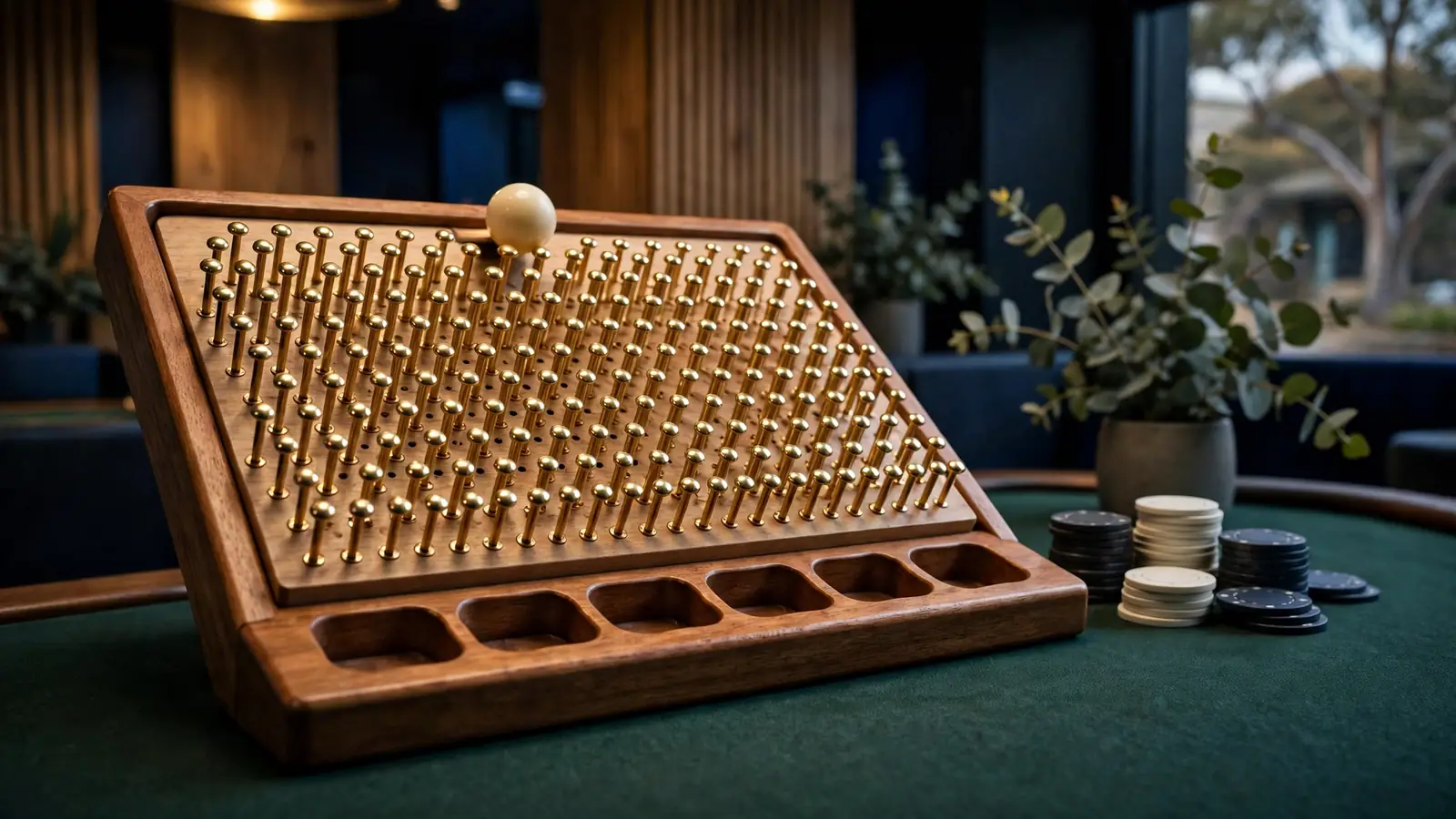
A Plinko-style game is easiest to understand as a path through a board. A ball enters near the top, meets a sequence of pegs and moves left or right at each contact until it reaches a slot at the bottom. The slot it lands in determines the outcome assigned to that path. This simple layout can make the result look traceable, but seeing the route after it happens does not make the next route predictable.
The board’s shape sets the possible routes. The entry point, number and arrangement of pegs, and positions of the bottom slots all affect which endpoints are available. A game may attach different values to different slots, so two routes that look similar can produce different outcomes. To assess the game conceptually, separate two questions: how likely each endpoint is, and what result the game assigns to that endpoint. Neither question can be answered just by watching a few balls fall.
In a physical board, small differences in a ball’s position, speed, spin or contact with a peg can change its direction. In a digital version, the animation may depict a ball following a path, but the visual movement alone does not establish how the result is generated. The display is an illustration of an outcome, not evidence that the next ball will follow a related route.
A sequence of results can appear to form a pattern: several balls may land on one side, or a high-value slot may be followed by low-value ones. Those observations describe what has already happened. They do not show that the board is correcting an imbalance or that a particular endpoint is “due”. If each round is generated independently, earlier results do not alter the next one. If a game uses another design, its rules would need to establish that; the animation cannot establish it by itself.
This distinction matters when people look for a launch position, timing method or sequence of choices that seems to favour an endpoint. A repeated action can change the conditions only if the game’s rules make that action relevant. Without such a rule, repeating it does not turn observation into prediction. Even a route that appears balanced across many drops can produce uneven clusters over a shorter run. Randomness does not mean every small sample must look evenly spread.
Risk depends on more than the most noticeable possible result. A board with outcomes concentrated near the centre behaves differently from one that assigns substantial weight to outer slots, even if both have the same number of endpoints. The distribution of possible outcomes matters: a rare large result may sit alongside many smaller ones, while a narrower range may produce less variation from round to round. The labels on the slots show possible outcomes, but not their likelihood.
When rules provide a probability for each endpoint, you can compare those probabilities with the outcomes assigned to them. When the rules do not provide enough information to establish those probabilities, a handful of observed drops cannot fill the gap reliably. More observations can describe a recorded sample, but they cannot prove that the next result is knowable or that the sample captures every possible path.
Treat a Plinko game as a chance-based system, not a puzzle with a hidden sequence to decode. Decide beforehand what level of uncertainty you are willing to accept, and stop rather than increasing stakes to recover a loss. Gambling is for adults aged 18 or older, and it can cause serious harm, particularly for vulnerable people.
A Plinko review can contain several different kinds of statements: descriptions of the game, claims about its performance, and opinions about whether it is enjoyable. They should not be read as equally reliable. A description can be checked against the game itself; an opinion belongs to the reviewer; a numerical claim needs enough context to be meaningful.
Start with the exact game being discussed. Similar names, such as Plinko Rush or Plinko Deluxe, do not establish that two games share a developer, rules or return figure. A review should identify the title and provider clearly. If it uses a familiar public figure’s name, such as MrBeast, treat that as branding to verify, not proof of an official connection.
A stated return-to-player percentage is a statistical description, not a forecast of what one person will receive. It does not show how a particular session will go, nor does it prove that a review has tested the game or independently checked its figures. Look for the game and provider to which the number applies, and whether the review explains where the figure came from.
For comparison, KA Gaming slot RTP figures typically fall between 94% and 96%. That range concerns the provider’s slots; it should not be transferred to a Plinko game, or treated as evidence about a particular title, unless the review establishes that connection. A percentage without a clearly identified game and source is not a useful basis for comparison.
The word “verified” also needs detail. A review should say what was checked and how. A screenshot or copied figure may show what a page displayed, but does not, by itself, establish the game’s underlying return or the reviewer’s method. If the method is not explained, regard the figure as a claim rather than a demonstrated result.
Read descriptions of rules separately from phrases such as “best,” “trusted” or “high-paying.” Those labels are judgements, not measurements. A useful review explains the feature behind each judgement and distinguishes observed interface details from claims about outcomes.
Check whether the article names limitations, corrections or uncertainty, and whether its statements stay consistent throughout. If a review says that a game is free to try, that tells you something about the mode being described; it does not validate claims about paid play. Likewise, a review of a game is not proof that a casino is authorised to offer it in Australia.
When comparing reviews, prioritise specific, checkable details over confident language. If two pages give different return figures, do not average them or choose the more attractive number. First establish whether they refer to the same title, provider and version. Where that cannot be established, the comparison has no reliable foundation.
A free-play mode can help you learn how a Plinko-style game presents its controls and results. You can see where the game displays the selected stake, how a drop is started, how the animation proceeds and where the result appears. If the interface includes adjustable settings, practice can show you what each control changes on screen.
That is a narrow purpose: learning the sequence and layout. It does not establish what would happen in a real-money game. A practice balance is not money you can withdraw, and a result shown in free play does not predict a later result. Even repeating the same actions cannot turn a practice session into evidence about real-money outcomes.
Treat labels such as “free play” or “demo” as descriptions of a mode, not proof that every version of a game behaves identically. The interface, available settings and displayed balance may depend on the particular implementation. If a mode differs from another version, what you learn about its controls may not transfer.
Free spins are also a separate term to interpret carefully. They describe a feature associated with certain games; they do not necessarily mean that a Plinko interface has a practice mode, or that any resulting balance is withdrawable. Read what the mode actually does rather than inferring its conditions from its name.
Use practice only to understand the sequence of actions and the information the interface displays. Do not use a short run of outcomes to estimate what a later session will produce, or to decide that a particular pattern is dependable. Free play can make the controls familiar; it cannot demonstrate a return, guarantee a result or establish the conditions of real-money play.
The distinction matters even when no payment is involved: familiarity with a screen is not the same as knowledge of how an outcome will be generated or what it would mean in another mode. If the display does not explain a control clearly, practice may reveal its visible effect, but it cannot answer questions about conditions that the interface does not state.
A crypto withdrawal can appear fast while still delivering less value than the displayed balance suggests. A specialist review reports that crypto withdrawals can clear faster than other methods, but also notes two costs that affect the amount received: network fees and conversion spreads. Speed describes how quickly a transfer is processed; it does not describe its net value.
A network fee is charged for processing a transaction on the relevant blockchain. If the withdrawal is sent in cryptocurrency, this fee can reduce the quantity that reaches the receiving wallet. The size and handling of the fee depend on the transaction and the service’s stated terms, so check whether the displayed withdrawal amount is before or after the deduction.
A conversion spread matters when the balance is valued in one currency but paid or assessed in another. The exchange rate used for the conversion may differ from a reference market rate. That difference reduces the value received, even if the coin quantity sent appears unchanged. For a crypto Plinko balance, the useful comparison is therefore not just the transfer time or the stated coin amount, but the amount remaining after both costs are accounted for.
Before confirming a withdrawal, identify the denomination of the displayed balance, the currency that will arrive, any network fee, and the exchange rate or conversion method. If the service does not show these clearly, the final value is difficult to estimate in advance. A crypto casino Plinko page may present a balance in digital currency, but that display alone does not establish what the converted amount will be.
The same distinction applies when a page describes a Plinko casino script or a crypto payment option: a technical label does not explain the fee calculation. Treat the quoted speed and the net amount as separate details, and compare like with like. A fast transfer can still have a lower effective value once network charges and conversion costs are applied.
A bonus is not cash simply because it appears in an account balance. Its terms may require you to place qualifying bets before bonus-derived winnings become withdrawable. The wagering requirement is a multiplier applied to a stated amount; the terms must also say whether it applies to the bonus, the deposit, or both. Those bases produce different totals, so the multiplier alone is not enough to calculate the condition.
A specialist review gives one worked example: a $100 bonus with a 40x wagering requirement calls for $4,000 in bets before winnings derived from that bonus can be withdrawn. This illustrates how a seemingly modest bonus can create a much larger turnover condition. It is an example reported by that review, not a universal rule. Read the terms attached to the specific offer rather than assuming the same multiplier or calculation applies elsewhere.
Games can also count differently toward the requirement. A specialist review reports a case in which blackjack contributes only 10% of qualifying wagers. Under such a rule, a bet may add only a fraction of its stake to the progress meter. If a game is excluded, its bets add nothing. The terms therefore determine not only how much wagering is required, but which activity advances it.
A no-deposit label does not remove these conditions. It describes how the bonus is provided, not whether the resulting balance can be withdrawn immediately. Before treating a Plinko-related bonus as usable funds, check the qualifying games, contribution rates, expiry conditions and the precise calculation base. If those terms are unclear, the displayed balance does not tell you what can be withdrawn.
For Australian readers, this explanation is about how bonus wording works, not an invitation to take up an online casino offer. Bonus-derived funds remain subject to their stated wagering conditions; they are not equivalent to cash available on demand.
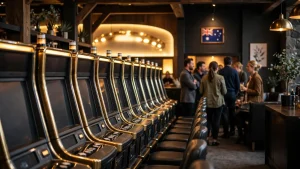
A report by gamble.com.au put Victorian poker-machine losses at $2.6 billion over the year it covered, more than $44.7 million above the figure for 2015. These are statewide totals, not a prediction of what any individual will lose. They show the scale of money flowing through pokies, but an aggregate figure cannot describe how losses are distributed among players or what any one person experiences.
The report also singled out the Epping Plaza Hotel in Melbourne’s north: its 100 machines generated more than $21 million over the period covered. Venue revenue and player losses describe opposite sides of the same flow of money. Neither figure, on its own, explains the circumstances of the people who played or the harm they may have experienced.
The figures help explain why bet limits became a policy issue. Senator Nick Xenophon and MP Andrew Wilkie proposed limiting poker-machine bets to $1. The proposal was an intervention aimed at the amount that could be wagered on a single bet; it should not be confused with a claim that a limit would eliminate losses or prevent every form of gambling harm.
A bet limit changes one part of the mechanism: the maximum stake available for each play. Its effect on total losses would also depend on how people respond, including how often they play. The proposal therefore represents a choice about reducing the scale of individual bets, not a guarantee about the eventual result.
Pokies losses can cause serious harm, particularly for vulnerable individuals. Statewide totals and venue-level revenue make the economic scale visible, while the debate over a $1 limit concerns whether restricting bet size is an appropriate way to reduce that harm.