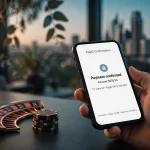
A Booongo label identifies a game's association with its provider, while the casino hosts the catalogue and account services.

A Booongo slot and the casino page where you encounter it are different parts of the experience. The slot is the game being presented; the casino platform is the service that displays its catalogue and manages the player’s account. Keeping those roles separate helps you understand what a provider label tells you—and what it does not.
When a casino identifies a game as Booongo-branded, the name points to the game’s association with Booongo, not to the casino itself. The casino is the host: it provides the site interface through which you browse and access games. A provider label therefore answers a narrower question than “Which casino is this?” It does not, by itself, tell you who operates the site, what other games it carries or what conditions apply to using its services.
This distinction matters because a casino’s catalogue can contain games associated with different providers. The platform brings those entries together, while each game retains its own identity. The casino may arrange titles into categories or show provider names in its lobby, but those display choices belong to the platform. They are not evidence that the casino created the game or that every item in its catalogue comes from the same source.
Choosing a Booongo casino in Australia involves more than the games: licensing and practical payment details can help you decide where to look. Use these notes as a starting point and check the terms that apply to you before signing up.
JustCasino
JustCasino is listed with a licence from the Curacao Gaming Control Board. You can use that licensing detail as one point to consider when reviewing the casino.
Playfina Casino
Playfina Casino is licensed by Curacao eGaming through Hollycorn N.V., which has held the licence since 2017. Its minimum deposit is A$20–30, depending on the offer.
LevelUp Casino
LevelUp Casino is licensed by Curacao eGaming under OGL/2023/174/0082, held by Dama N.V. Its minimum deposit is A$15.
Roby Casino
Roby Casino is licensed by Curacao eGaming through Roby Games Ltd. That licensing information may help you assess whether it suits your preferences.
Golden Pokies
Golden Pokies is listed with a Curacao licence. You can take this detail into account as you review the casino.
MrPacho
MrPacho lists crypto payouts at 30–120 minutes and fiat payouts at 24–72 hours. Its minimum deposit is A$30.
House of Pokies
House of Pokies lists an international iGaming licence, though the source does not name the jurisdiction. PayID payouts are listed at 1–24 hours; the minimum deposit is A$30, or A$10 for PayID.
DragonSlots Casino
DragonSlots Casino is licensed by the Curacao Gaming Authority through Jumpman Gaming Ltd. You can consider this licensing detail when evaluating the casino.
LuckyVibe
LuckyVibe is licensed by the Curacao Gaming Control Board under OGL/2023/176/0095, held by Hollycorn N.V. This gives you a specific licence reference to check.
Lucky Dreams
Lucky Dreams has a Curacao licence and lists a minimum deposit of A$20 for POLi. These details can help you judge whether its licensing and deposit threshold fit your needs.
A title’s presentation can combine several kinds of information: a game name, a provider label, a category and descriptive language about its appearance or format. These details do different jobs. The name identifies the individual entry; the provider label indicates its association; the category helps organise the catalogue. Promotional wording, by contrast, may be intended to attract attention and should not be treated as a technical specification.
The same care applies to terms such as “3D”. The word may describe how a game is presented, but the label alone does not establish what its visuals look like, how they are rendered or what functions it includes. To understand a particular title, you would need information attached to that title itself. A general provider label cannot supply those details.
Nor does a broad description such as “best” identify a measurable quality. It could refer to someone’s preference, a catalogue’s featured placement or an editorial judgement. Without a stated basis for comparison, it does not tell you how one game performs against another. Treat such wording as a description of the page’s framing, rather than a property you can verify from the provider name.
A slot operates within a larger chain of interfaces and services. The platform presents the game entry; the game itself supplies the play experience; and the casino’s account and service systems sit around that access. These layers can appear together on one screen, but they remain distinct. A problem with a site account, for instance, is not automatically a property of the game, just as a game’s presentation does not describe every feature of the casino platform.
This separation also helps when comparing listings. Two casinos could display games with the same provider label, yet their sites may differ in layout, catalogue organisation and account processes. Conversely, one casino may host entries associated with multiple providers. The provider name is therefore useful for sorting or identifying content, but it cannot stand in for an assessment of the host platform.
The phrase “Booongo slots” can refer broadly to slots presented under that provider identity. It does not identify one specific game or guarantee a shared set of mechanics across every title. A provider-level label is a grouping clue, not a substitute for the individual game description. If you are trying to understand a particular entry, use the title’s own information rather than assuming that all games carrying the same label behave alike.
A provider label can help you distinguish game content from the casino that hosts it. It can also help narrow a catalogue when you are looking for a particular provider’s work. But the label alone does not establish a title’s exact appearance, rules, availability or access mode. Those questions belong to the individual listing and the platform’s presentation of it.
The practical way to read a casino lobby is to separate its layers: identify the game entry, note the provider attribution, and recognise the casino as the host. Then interpret descriptive terms only as far as their wording supports. This avoids treating a catalogue category as a technical claim or confusing the identity of a game with the identity of the site displaying it.
For Australian readers, the distinction is descriptive rather than an endorsement of real-money play. A game label explains how content may be categorised; it does not change the legal status of the service offering it.
For Aussie gamblers considering a Booongo-branded game on an offshore casino site, the key legal distinction is between the company supplying the service and the person using it. The Interactive Gambling Act 2001 prohibits a company from providing real-money interactive casino games to people in Australia. That prohibition covers casino-style play, including slots and table games. It does not make an individual player’s use of a foreign-licensed site a criminal offence.
That distinction does not mean offshore casinos are locally regulated or that Australian consumer protections follow you to them. Real-money online casinos do not have domestic licences available in Australia. A site operating from overseas is therefore not covered by the same domestic oversight that applies to services regulated within Australia.
The Act places its relevant restriction on providing the gambling service to people in Australia. The player’s legal position is separate: playing at a foreign-licensed casino is not, by itself, criminalised under that law. This is a narrow statement about the player-facing rule, not a claim that an offshore operator is approved to serve Australians or that every possible dispute is resolved under Australian protections.
Domestic regulators such as the Australian Communications and Media Authority (ACMA) have powers and responsibilities within the Australian regulatory system. Those protections do not extend to an offshore casino platform simply because you are accessing it from Australia. If a disagreement arises over an account or a casino’s handling of a game, you should not assume that a domestic regulator can provide the same complaint process or remedies available for a locally regulated service.
A foreign licence and Australian regulatory coverage are not interchangeable. A licence issued overseas may relate to the operator’s obligations under the licensing system that issued it; it does not create an Australian casino licence or bring the platform under ACMA’s consumer-protection arrangements. The location of the game provider also does not change that distinction. A Booongo label identifies game content, not the regulatory status of the casino hosting it.
Read the site’s terms and privacy information before opening an account or placing a real-money wager. Check which company operates the platform, what jurisdiction it identifies, and what process it sets out for complaints. These details help you understand which entity you would be dealing with, but they do not turn the service into a domestically regulated casino.
Also separate a site’s own statements from Australian legal status. A platform may describe its licence, game catalogue, or player support, but those claims do not establish that Australian consumer protections apply. If the site’s rules or dispute process are unclear, you cannot rely on ACMA protections to fill in the gaps for an offshore platform.
Legal Prohibition
The Interactive Gambling Act 2001 prohibits companies from providing real-money interactive casino games to people in Australia. Using offshore platforms means you are not covered by domestic oversight or ACMA consumer protections.
The same care applies when a casino presents Booongo content as a reason to play. Game branding does not determine whether the operator may provide real-money casino services in Australia, and it does not extend domestic protections to an offshore account. Consider the legal position and the limits of recourse before treating a site’s promotion or licensing claims as assurance.
The practical takeaway is precise: Australian law prohibits companies from providing real-money interactive casino games to people in Australia, while it does not criminalise the individual player for using a foreign-licensed site. At the same time, domestic casino licensing is unavailable and ACMA protections do not carry over to offshore platforms. Keep those points distinct when assessing any online casino.
A mobile label does not establish that a particular Booongo game works on your phone. It may refer to a casino website that adjusts its layout for a small screen, a downloadable app, or a provider’s games being accessible through a mobile interface. These are different claims, and each needs its own evidence.
Keep the game provider and the casino platform separate. Booongo is the name associated with the games; a casino site is the service that displays its catalogue and handles the account. A mobile-friendly casino homepage does not, by itself, prove that every game in its catalogue is available on mobile. Nor does a game appearing in a provider list establish that it will load on a particular device or operating system.
To assess a mobile claim, identify exactly what is being described. Is the claim about the casino’s website, its account services, or a specific game? Look for a current, explicit statement from the operator or provider that names the relevant device or access method. General wording such as “mobile casino” is not enough to establish app availability, browser compatibility, or support for a particular operating system.
If you can lawfully view a product page or catalogue, treat it as evidence of presentation, not proof of performance. A title listed under a provider name only shows that the operator attributes it to that provider. It does not establish that the game opens on your device, that its controls suit a touchscreen, or that its display remains usable when the screen changes orientation. Those details require a direct, current test or clear documentation. Do not infer them from a desktop screenshot or a broad mobile claim.
The same distinction applies to the phrase “Booongo mobile casino.” It can describe a casino site that includes Booongo content, but it does not identify a separate mobile product or guarantee that the provider’s full catalogue is accessible there. “Live casino” also describes a different category of casino content; the wording alone does not verify that Booongo offers live dealer games. A provider name attached to a casino page is not evidence of every game format a reader might associate with the term.
For Aussie readers, there is an additional boundary: mobile access does not change the legal status of the service. The Interactive Gambling Act 2001 prohibits operators from providing real-money online casino games to people located in Australia. A site being reachable on a phone, or describing itself as mobile-compatible, does not make that provision lawful in Australia. The law does not make an individual player’s act of using a foreign-licensed site a criminal offence, but offshore platforms do not carry the protections available through domestic regulators such as ACMA.
A careful assessment therefore separates three questions: whether the site’s mobile interface is documented, whether a specific Booongo game is confirmed for that access method, and whether the service may lawfully provide real-money casino play where you are. Evidence for one question cannot answer the others. Treat broad compatibility language as a claim to verify, not as a technical specification or a sign of regulatory approval.
A bonus changes the conditions attached to play; it does not make the credited amount immediately withdrawable. The key condition is the wagering requirement: it specifies how many times the bonus amount must be wagered before bonus-related winnings can be withdrawn. Until you meet that requirement, the casino may keep the withdrawal unavailable. If you request a withdrawal while wagering is still active, it may be declined, or the bonus and associated winnings may be forfeited.
The calculation depends on the terms. Check whether wagering applies to the bonus alone or to the deposit and bonus together, and what counts as eligible play. A specialist review reports that pokies bonus requirements can fall between 30x and 45x the bonus amount, while a 60x requirement on the combined deposit and bonus can keep funds tied up through substantial play. These are reported examples, not terms you can assume apply to a particular offer. Read the offer’s full conditions before accepting it.
A game’s contribution determines how much of each wager counts toward clearing the requirement. Slots generally count in full, while live-table play contributes less; some instant-win formats may not count at all. A wager can therefore produce very different progress depending on the game you choose. If a game is excluded, playing it may fail to advance wagering and can put bonus winnings at risk.
Do not infer a game’s contribution from its appearance or provider. The offer terms are what matter. They should identify eligible games and state how each category contributes. If the wording is unclear, treat that as unresolved before you start wagering rather than assuming all games count equally.
Bonus terms may also set a maximum bet while wagering is active. Exceeding that limit, or playing excluded games, can void bonus winnings. Check the stated maximum before each bet and keep play within it until the requirement is cleared. A large bet does not necessarily speed up progress safely: if it breaches the conditions, the casino may remove winnings instead.
For any Booongo-related bonus, first establish whether an offer is actually available and then inspect its terms. A welcome offer, deposit promotion, or bonus advertised as free can each have different requirements; the label alone tells you neither the wagering basis nor the permitted games. Do not assume that a bonus exists for a particular Booongo game or casino.
Before accepting an offer, review its wagering basis, game weighting, maximum bet, excluded games, and withdrawal conditions in full. Keep a record of the active terms. You can then judge whether the play required to clear the promotion fits your budget, and avoid treating a displayed bonus balance as money ready to withdraw.
A Booongo-branded game, if offered by a casino, sits within a wider service: the casino operates the account and provides access, while the game provider supplies its own content. The site’s offshore licence concerns the operator’s home jurisdiction. It does not amount to Australian authorisation to offer real-money casino games to people in Australia.
Most online casinos that accept Australian players are registered in jurisdictions such as Curaçao, Malta, or Anjouan.
That distinction matters when you come across a site presenting Booongo pokies or other casino games to Aussie punters. Most online casinos that accept Australian players are registered in Curaçao, and offshore casinos licensed in Curaçao, Malta or Anjouan are commonly used in response to restrictions on local pokies. Their presence in the market should not be confused with domestic regulation or approval.
Australian law sets a different boundary. The Interactive Gambling Act 2001 prohibits operators from providing real-money online casino games to people physically located in Australia. This includes online pokies and other casino-style games. An offshore licence may indicate that an operator is regulated where it is based, but it does not override that Australian restriction. Offshore casino services may also be blocked, so a site appearing in a listing or being reachable at one time does not establish that access will remain available.
For anyone assessing a site that claims to offer Booongo content, separate three questions: whether the operator has a licence in its own jurisdiction, whether the site actually lists the games you are looking for, and whether the service is available to people in Australia. These are distinct points. A licence claim does not prove that a particular game is present, and a game listing does not establish Australian authorisation.
The term “trusted” can also conceal this difference. Trustworthiness is not established simply by the presence of a foreign licence, nor does that licence provide the protections available through Australian regulators such as the Australian Communications and Media Authority. A site’s regulatory status in one jurisdiction should therefore be read as a statement about that jurisdiction, not as a local endorsement.
Searches for the best Booongo casino sites can make offshore platforms look like a straightforward category, but the label alone tells you little about the operator’s Australian status or what games it currently offers. Treat references to Booongo online pokies as claims about content that need to be checked on the relevant site, not as evidence that the casino is authorised in Australia. The key distinction is between an offshore operator’s licensing context and the rules governing real-money casino services for people in Australia.
A casino platform and the games shown in its lobby are separate things. A platform may group games by provider, while a third-party directory may describe a casino as carrying Booongo content. Those are different claims: one concerns how a site labels its catalogue; the other reports what a directory believes is available.
Catalogue information can change. A provider filter, where present, reflects the platform’s current categorisation, while a directory page may remain online after its details have changed. A listing is therefore not, by itself, proof that a particular game is currently accessible through a particular operator. Nor does a mention of Booongo establish that every game attributed to the provider is offered there.
Terms such as “Booongo live casino” can also blur distinct categories. “Live casino” commonly describes dealer-led table games streamed from a studio; a provider label in a slot catalogue refers to software attribution. Treat the wording as a claim to interpret, not as evidence that a provider offers live-dealer games. The same care applies to a “latest” listing: the label says little unless the page makes clear what was updated and when.
For a general directory, useful checks are editorial rather than promotional:
These checks help you assess what a list actually establishes without treating a “top” label as a quality measure. Ranking language can reflect editorial choices, commercial relationships or changing catalogue data; it does not demonstrate game availability, fairness or suitability.
For Australian readers, there is also a legal boundary: the Interactive Gambling Act 2001 prohibits operators from providing real-money online casino games to people physically located in Australia. A directory entry does not change that rule or make a service locally authorised. Player protections available through domestic regulators such as ACMA do not apply to offshore platforms.
The practical distinction is simple: a provider name on a directory is a lead about categorisation, not a guarantee about a platform’s current contents or a recommendation to use it. Treat lists as descriptions that may need qualification, and keep the regulatory setting separate from any claim about what a casino catalogue displays.
A Booongo slot demo and no-deposit access are different kinds of access. A demo lets you try a game without staking real money; a no-deposit offer, if one is available, is a promotion that may let an eligible account play without making a deposit first. Neither should be assumed to exist just because a casino lists Booongo content or uses “no deposit” in promotional material.
To establish whether a demo is actually available, check the specific game page or launch screen. Look for a clearly labelled demo or practice option, and confirm that it opens without requiring a real-money balance. A game that loads on a casino site is not automatically a demo: it could require an account, use real-money play, or be unavailable to visitors in your location. Do not infer access conditions from a game’s provider name alone.
No-deposit access needs a separate check. Read the offer’s eligibility rules and terms before registering or activating anything. Confirm whether the promotion is restricted to new accounts, whether a code must be entered, which games it covers, and what conditions apply before any winnings can be withdrawn. A promo code is not proof that an offer is active or that it applies to Booongo games. If the terms do not clearly identify eligible games and access requirements, treat the offer as unconfirmed rather than relying on a banner or headline.
The same checks apply when considering a newly launched casino or a site described as one of the top Booongo casino sites. A new label does not establish that the platform provides demo play, no-deposit access, or a working promotion. Verify the operator’s current terms and the actual game launch path; do not rely on a list, search result, or third-party description as confirmation.
For Aussie gamblers, there is also a distinction between trying a demo and accessing real-money casino play. The Interactive Gambling Act 2001 prohibits operators from providing real-money online casino games to people in Australia. A demo label or no-deposit promotion does not change that legal position, and it should not be treated as permission to play for money.
In practical terms, verify each claim at the point where access is offered: the game screen for demo mode, and the promotion terms for no-deposit eligibility. If either is unclear, you cannot safely assume that the access exists or that it works as advertised.
“Casino software” can refer to different parts of an online gambling service. It may mean the games themselves, the software that displays and runs them, or the casino platform that handles accounts and play. These are not interchangeable. A Booongo label associated with a game would identify its provider, not establish which platform hosts it or what play options that platform makes available.
The word “free” also needs context. Free play means a session that does not use a real-money stake, while real-money play involves wagering funds. Seeing a free-play label does not, by itself, tell you whether a game can be opened without an account, whether the session is a demonstration, or whether it is available at a particular casino. Those conditions depend on the operator’s interface and terms; the label alone cannot confirm them.
Nor does free play necessarily mean that the session behaves like real-money play in every respect. A free session should not be treated as evidence about cash stakes, withdrawals, or the availability of a particular game for paid play. Check what the screen says about the mode before starting, and do not assume that a displayed balance represents money you can withdraw.
If a session is connected to a promotion, its wagering rules may matter even when the game itself is presented as free. Some instant-win formats may be excluded from wagering calculations entirely. That can affect whether promotional play helps meet a requirement, but it does not establish that a Booongo-branded game is included in any offer. The promotion’s terms determine which games count and under what conditions.
In Australia, the legal distinction is also important: the Interactive Gambling Act 2001 prohibits operators from providing real-money online casino games to people located in the country. A free-play description does not change the legal status of a real-money service, and it should not be read as an endorsement or assurance of access.
When evaluating a software label, separate three questions: who is identified as the game provider, which casino platform presents the game, and whether the available mode uses real money or promotional conditions. Keeping those questions apart prevents a search result or a “free” button from being mistaken for proof of a specific game, feature, or cash-play option.
A free-spin promotion can attach wagering conditions to winnings from spins, even when the spins themselves are provided without a separate stake. The key detail is not just which game is played, but how that game is weighted toward the promotion’s wagering requirement. The applicable terms determine whether a game counts and how much progress each bet adds.
Slots generally contribute fully toward wagering requirements. If a promotion’s terms count a slot at full contribution, eligible bets on it add more progress than the same-sized bets on a game with a lower weighting. Table games typically contribute only 10–20%, so a smaller share of each qualifying bet reduces the outstanding requirement. Live-table play contributes less than slots; check the promotion’s terms for its exact treatment rather than assuming it counts like a slot.
This distinction matters when free spins are associated with a particular game. Winnings may be subject to a wagering condition, but the game’s contribution rate affects how quickly that condition is cleared. A promotion can also restrict which games count. If the terms exclude a game, playing it may add no progress, even if it appears in the same casino’s catalogue.
Before accepting or using an offer, read its full terms, including eligible games, contribution rates, maximum bet rules, and any expiry conditions. Keep bets within the stated maximum and avoid games excluded from wagering. Exceeding a maximum bet or playing an excluded game can void bonus winnings. If wagering remains active, a withdrawal request may be declined; withdrawing before completion may also forfeit the bonus and related winnings.
Searches for free Booongo spins or free pokies can refer to different arrangements: free spins tied to a promotion, a no-cost game mode, or a real-money offer with conditions. Those are not interchangeable. The presence of a Booongo-branded game does not establish that free spins are available or that its play counts toward a promotion. Check the specific offer and game terms before relying on any expected contribution.
For Aussie gamblers, the practical test is to trace the rules from the reward to the game: identify which winnings are covered, which games qualify, and what contribution each receives. That tells you whether play advances the requirement and what remains to be cleared before winnings become withdrawable.
A real-money deposit and a withdrawal are separate transactions. The payment method used to add funds does not necessarily determine how you can receive them: Neosurf, for instance, is a deposit voucher and cannot be used for withdrawals. Casino payment menus may include cards, e-wallets and cryptocurrency, but credit cards must not be accepted for online gambling services in Australia. Offshore casino services are prohibited for operators offering them to people in Australia, and access may be blocked.
Before depositing, check which payment methods are available and whether the withdrawal options match your needs. The operator’s terms should explain any method-specific restrictions. If you use a deposit-only method, you will need another way to withdraw. Do not treat a payment option shown on a site as proof that the service is lawful or available to Australian residents.
Verification affects when funds can be released. A specialist review identifies incomplete account checks as a frequent cause of withdrawal delays. Casinos may ask for government-issued identification and proof of address before processing withdrawals above their stated thresholds. Complete the checks before requesting a payout, and ensure the account details and documents match; otherwise, the operator may pause the request while it resolves discrepancies.
After approval, the payment method and the operator’s processing steps affect how long funds take to arrive. PayID transfers reach a player’s bank almost immediately once the operator sends them. A specialist review reports that bank transfers averaged 3.2 business days in its testing, while credit-card refunds can take days after casino approval and may face additional bank delays. These are reported results, not a promise for any particular transaction.
Cryptocurrency has two separate stages: the casino releases the payout, then the blockchain confirms the transfer. A specialist review reports that confirmation commonly follows within an hour, but the casino’s release time comes first and can vary. A players’ forum also describes withdrawal requests being held for a period during which cancellation may be possible; check the operator’s terms rather than assuming that a submitted request is final.
Before playing, read the payment and verification rules together. They determine which route is available, what documents may be requested and which steps can delay access to funds.
Yes, Australian individuals are not criminalised for playing at foreign-licensed offshore casinos. However, the Interactive Gambling Act 2001 prohibits companies from providing real-money interactive casino games to people in Australia, and offshore sites are not covered by domestic player protections.
“Best” is not an objective measure on its own: it can reflect personal preference, featured placement or editorial judgement. A meaningful comparison needs stated criteria rather than relying on a provider label.
Pokies bonuses commonly require wagering 30–45 times the bonus amount before winnings can be withdrawn. Check the offer’s game-weighting and maximum-bet rules too: slots generally count fully, while table and live-dealer games usually count less, and some instant-win games may not count at all.
Timing depends on the payment method: tested Bitcoin Cash withdrawals took under four hours, bank transfers averaged 3.2 business days, and card refunds can take days after casino approval, with further bank delays possible. Verification checks and a casino’s 0–24-hour withdrawal hold can also affect the process.
Casino games include slots and table games, as well as live-dealer games. A casino catalogue may combine games associated with different providers.